Trendy Winter Business Casual Outfits With Polished Layers
Trendy winter business casual outfits work best when polish does not come at the expense of ease. Cold-season dressing adds visual weight and practical demands, so the challenge is creating enough structure to feel intentional while preserving comfort and natural movement. Clear proportions, controlled volume, and a sense of restraint can make the overall impression feel professional without becoming rigid or overly formal.
Visual clarity matters just as much as warmth because business casual style can lose definition when too many competing ideas occupy the same space. A strong winter approach gives each element a clear role, allowing shape, color, and scale to support one another rather than compete for attention. The result can feel composed and purposeful while still leaving enough softness and flexibility for everyday wear.
Pale Long Coat With Focused Red Accents
A long light neutral coat creates the dominant vertical line here, falling over pale wide-leg trousers and leaving only a concentrated section of vivid red-pink visible through the center. The similar values of the coat and trousers make the silhouette feel visually continuous, while the coat’s slight sheen gives the outer layer enough definition to remain distinct from the softer-looking lower half.
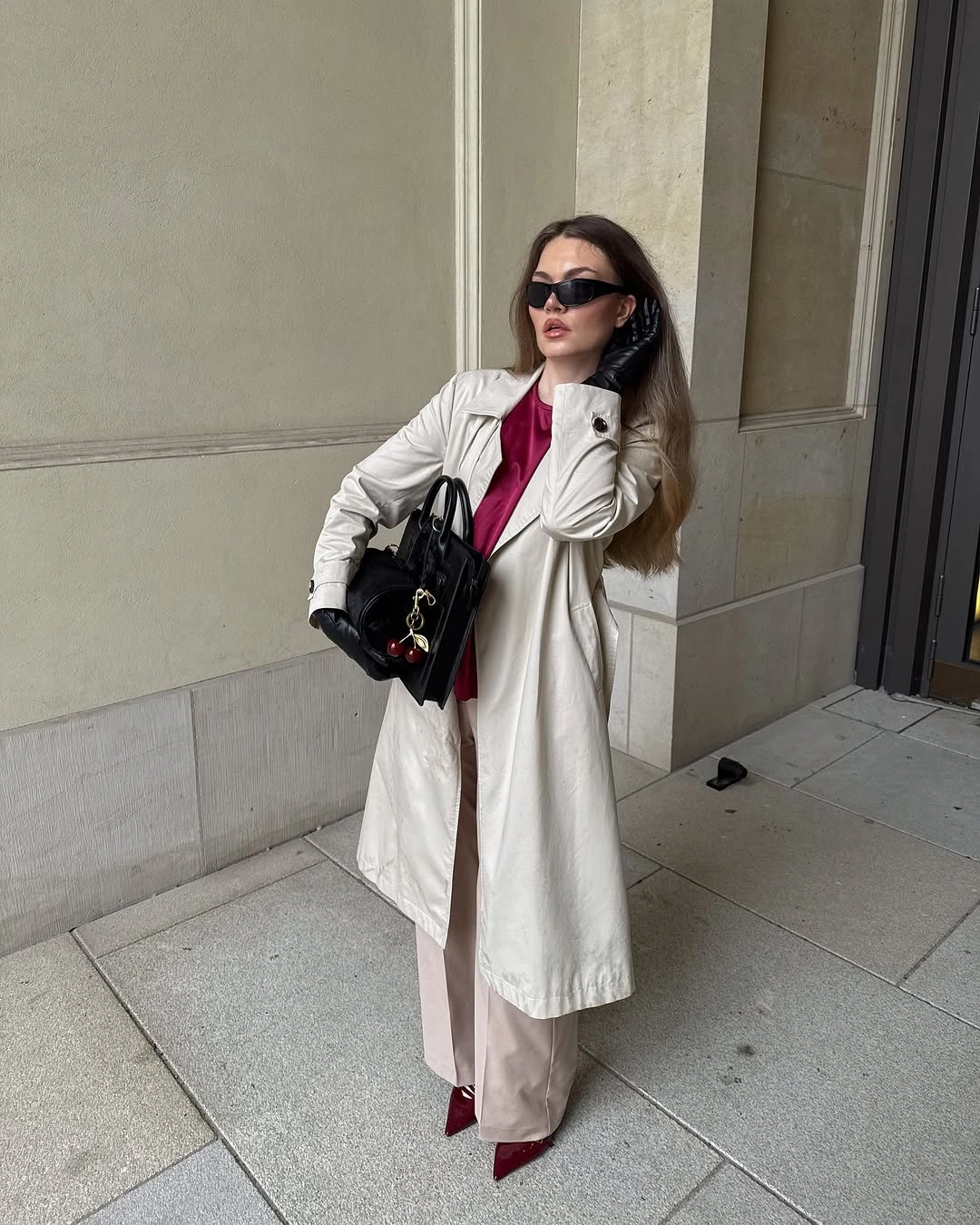
Color is used sparingly but with clear placement: the bright upper layer appears beneath the pale coat, then a deeper burgundy-red returns at the pointed shoes. Black gloves and a structured black handbag add smaller dark interruptions without competing with that color connection, so this business-casual winter look stays controlled even though it includes several strong accents.
The useful idea is not simply adding a bright color, but limiting it to precise points inside an otherwise restrained palette. A long neutral outer layer can carry most of the visual structure while a vivid center and pointed footwear keep the outfit from feeling flat.
Black Layers Sharpened by a White Collar
A black jacket and short pleated skirt form a compact dark silhouette, but the crisp white shirt collar immediately breaks that continuity around the neckline. Fine white linear detailing across the jacket adds another layer of contrast without changing the basic black-and-white palette, making the upper half visually intricate while the skirt remains comparatively simple.
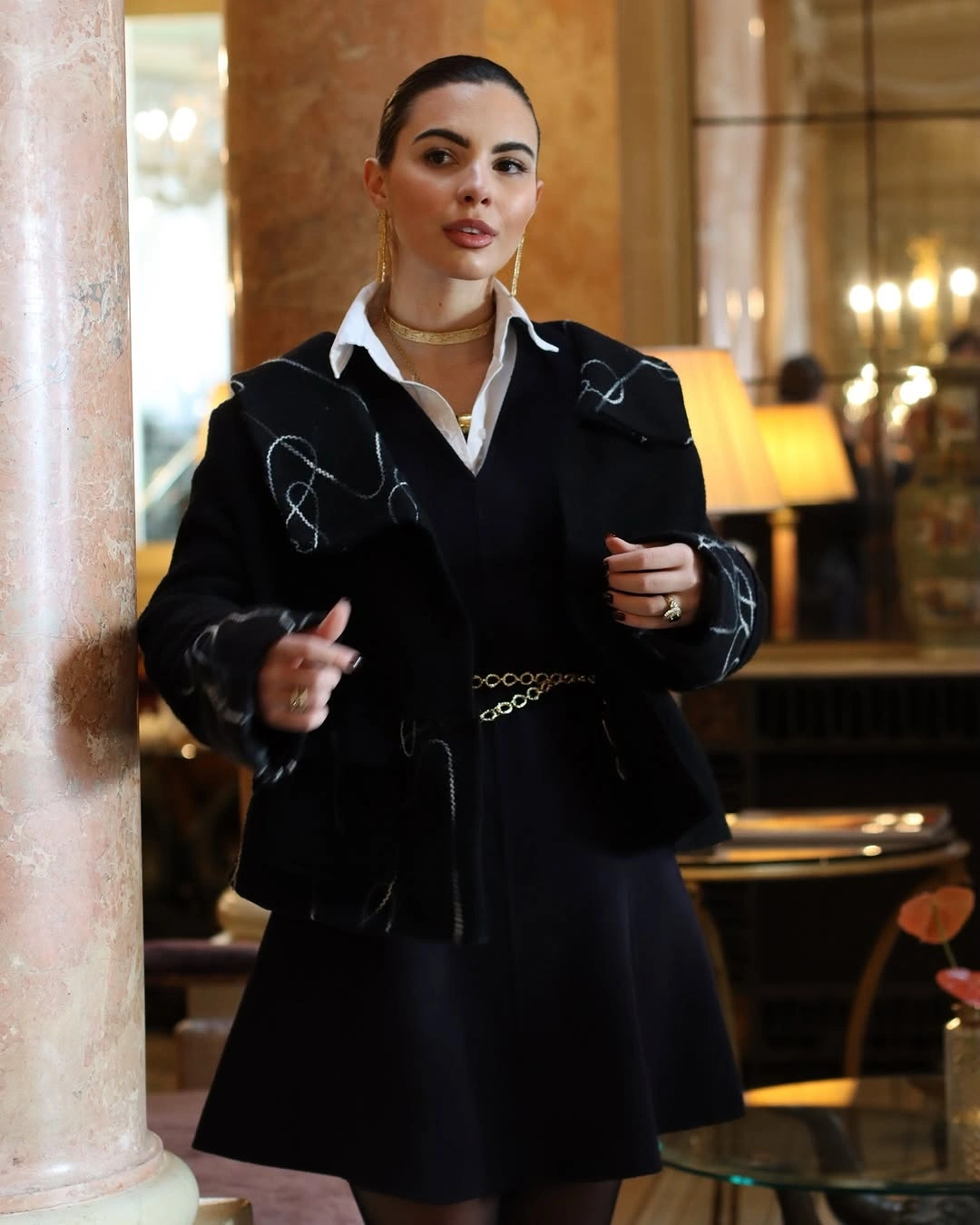
The waist receives a second point of definition through a slim chain-like detail, while gold-toned jewelry introduces smaller reflective accents near the face and hands. Because those elements are narrow and concentrated, they do not compete with the larger dark shapes. The result is a business-casual winter outfit built less on color variety and more on carefully placed lines and contrast.
This look shows how a compact silhouette can still feel highly structured without relying on a long coat or wide trousers. The white collar and small linear details do most of the separating work, keeping the black layers readable rather than merging into one block.
Oversized Black Tailoring With Controlled Proportions
An oversized black blazer sits over a dark top and long wide trousers, creating an almost uninterrupted monochrome column from shoulder to floor. With no strong color break between the major pieces, the outfit depends on changes in scale instead: the blazer adds broad upper volume, while the trousers continue that width downward in a straighter, elongated line.
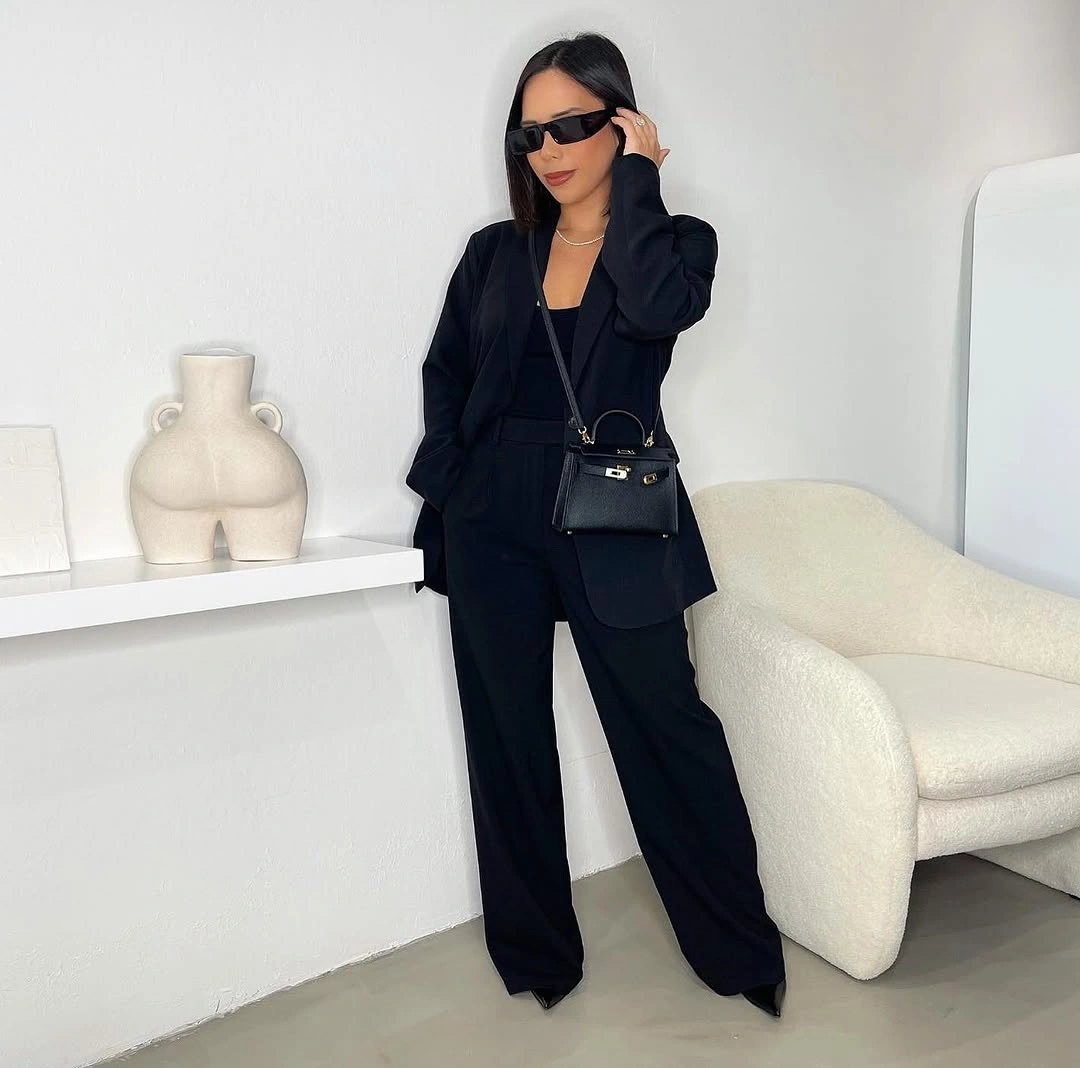
A narrow belt area and small structured bag worn at the waist provide the main point of visual compression inside the larger black silhouette. Their compact scale matters because it interrupts the generous proportions without introducing another color story. For winter business casual dressing, this is a clear example of how shape and accessory size can organize a monochrome outfit.
The strongest lesson here is that all-black dressing does not need extra color to create hierarchy. A large blazer, long trousers and one small structured focal point can make the proportions themselves carry the entire composition.
Fitted Black Top Meets Extra-Wide Trousers
The upper half stays close to the body in a fitted black top with sleeves ending around the elbow, while the trousers expand dramatically into a very wide leg. That sharp shift from narrow to broad gives the outfit its structure, even though the palette remains entirely dark. The clean contrast in volume makes the waist the natural transition point between the two shapes.
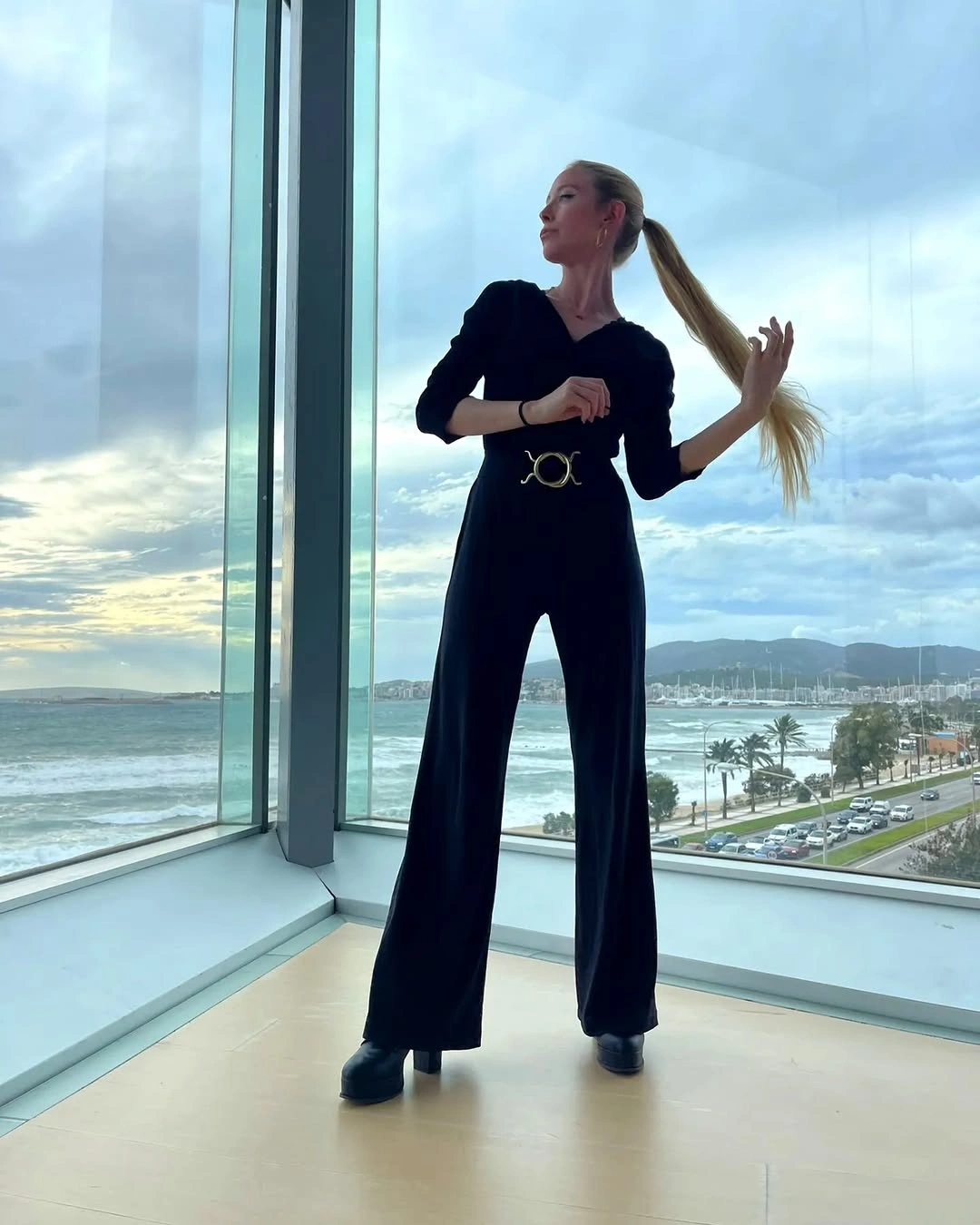
A prominent gold-toned circular belt detail sits exactly at that transition, interrupting the black column with a small but highly visible focal point. Because the trousers carry so much width below it, the centered accent helps keep the outfit visually anchored rather than letting the lower half dominate. This creates a business-casual winter formula based on proportion instead of layered color.
Compared with oversized tailoring, this approach uses a much closer upper line before opening into volume below. The result demonstrates how a defined waist can make very wide trousers feel deliberate and balanced without requiring a jacket or contrasting outer layer.
Deep Brown Outer Layers Ground Relaxed Denim
A long deep brown coat establishes the main vertical shape, while a similarly dark scarf extends that tonal area upward and keeps the top half visually unified. The coat falls well below the hip, so its length gives the outfit a stronger outer framework than the relaxed blue jeans would create on their own. A muted neutral layer is also visible beneath without drawing attention away from the darker outer pieces.
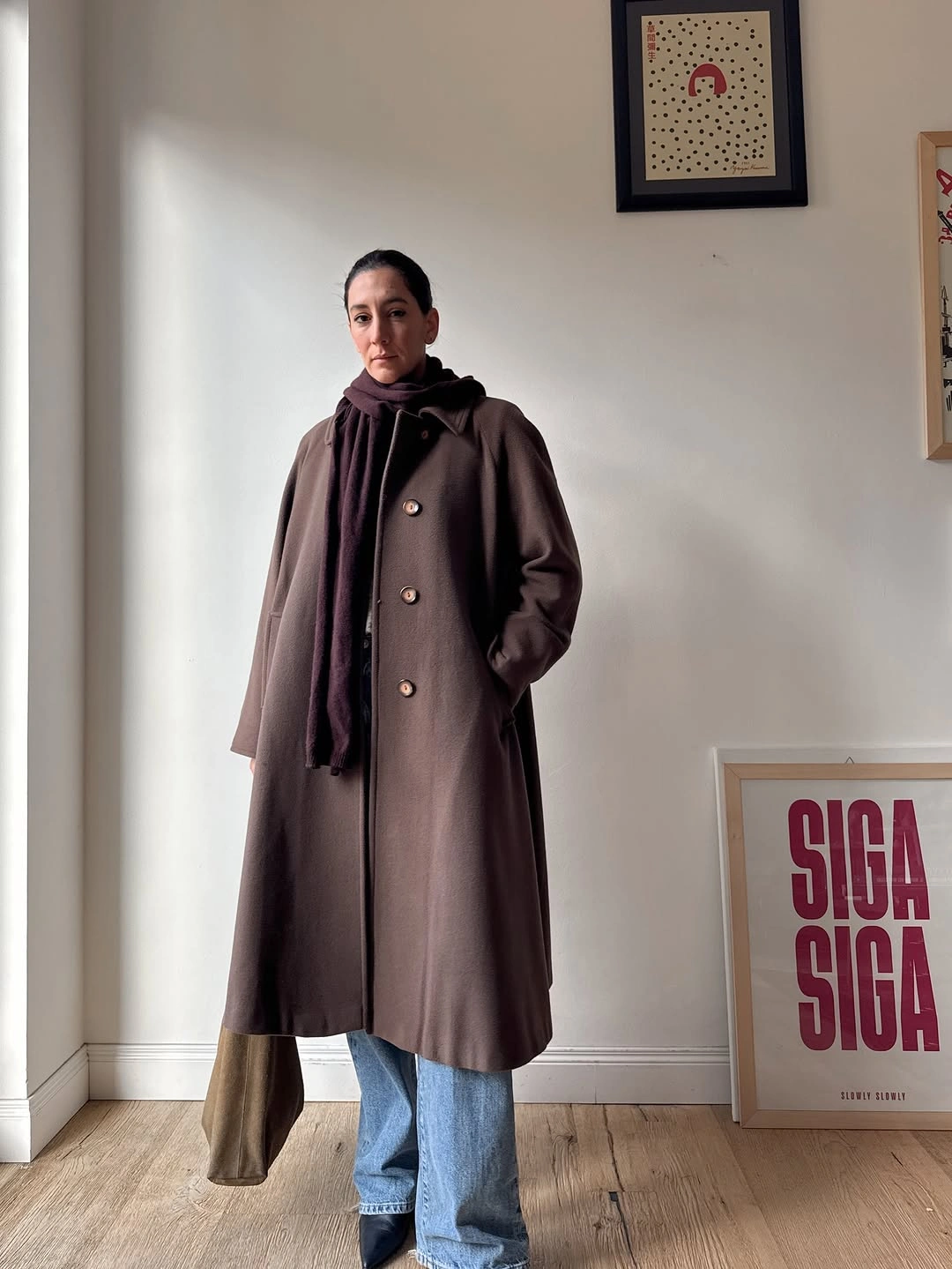
The blue denim introduces the clearest color change, appearing below the coat in a lighter and more casual-looking block. Because the coat and scarf occupy so much of the silhouette, that contrast feels contained rather than dominant. It is a useful business casual with jeans example where the long, restrained outer layer supplies most of the visual polish while the trousers keep the proportions relaxed.
The key relationship is between the continuous brown upper structure and the lighter denim below it. This shows how winter business casual outfits can accommodate jeans when the surrounding layers provide enough length, tonal consistency and visual order.
Oversized Taupe Coat Balanced by Black Boots
The long taupe-olive coat dominates the silhouette through sheer scale, with broad lapels, a generous shoulder line and a hem that reaches well below the knee. Its visibly plush surface adds depth without needing a busy color story, while the light top underneath creates a narrow vertical break through the center so the oversized outer layer still reads with definition.
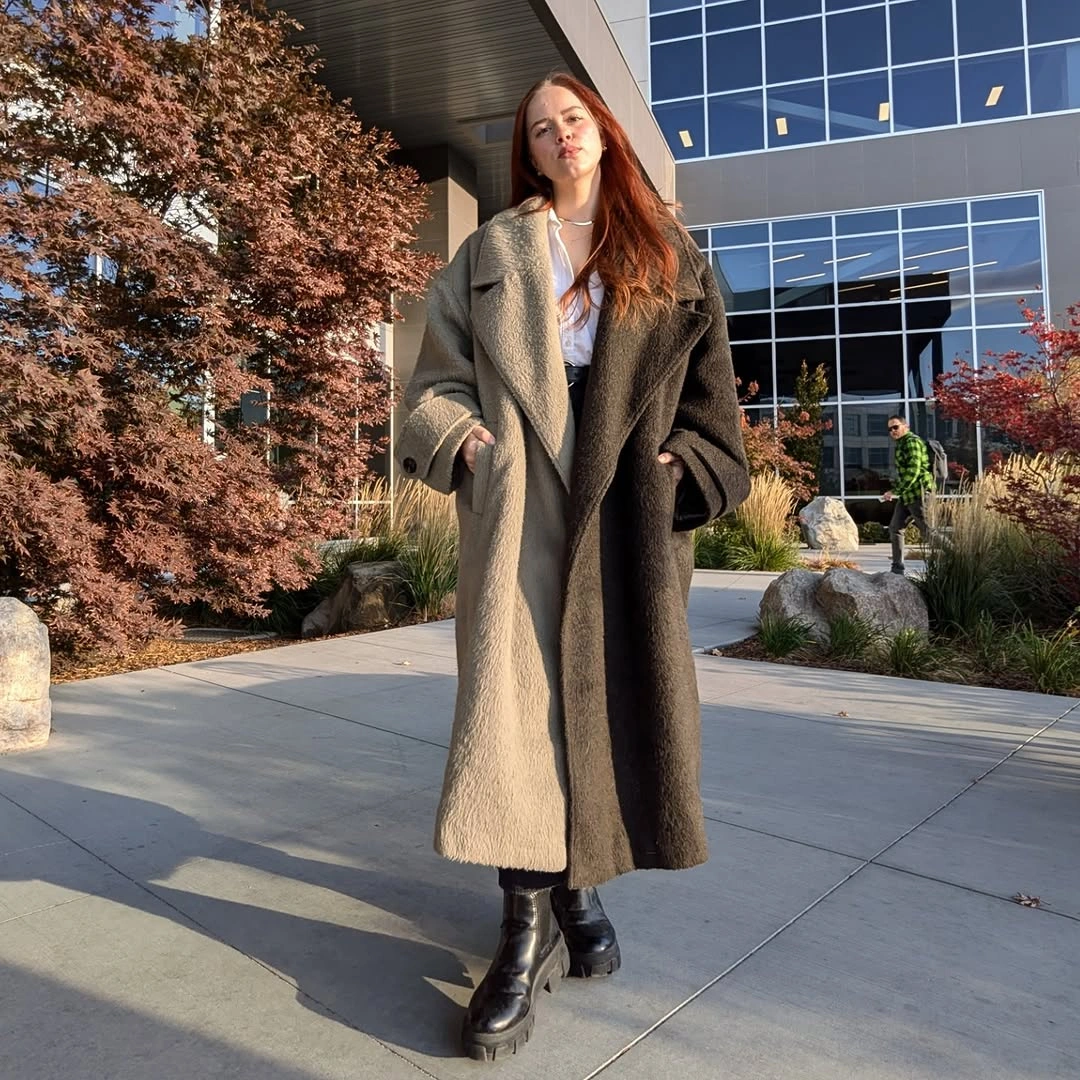
Tall black heeled boots give the lower half a firm visual anchor beneath the large coat, concentrating the darkest value close to the ground. That contrast matters because the outer layer carries so much width and texture above it. In a winter business casual outfit, this balance between expansive outerwear and a narrow dark base keeps the proportions deliberate rather than visually heavy.
The main idea is to let one substantial outer layer control the silhouette while keeping the rest visually quiet. A dark, narrow base can balance considerable coat volume without competing with its texture or scale.
Checked Layer With Crisp White Ruffles
A tan-and-white checked button-front layer creates the main pattern, sitting over a bright white blouse with a high ruffled neckline and matching ruffled cuffs. The check is small and regular, so it brings visual interest without overwhelming the lighter pieces around it. Wide white trousers continue that brightness downward and give the outfit a clear, open lower half.
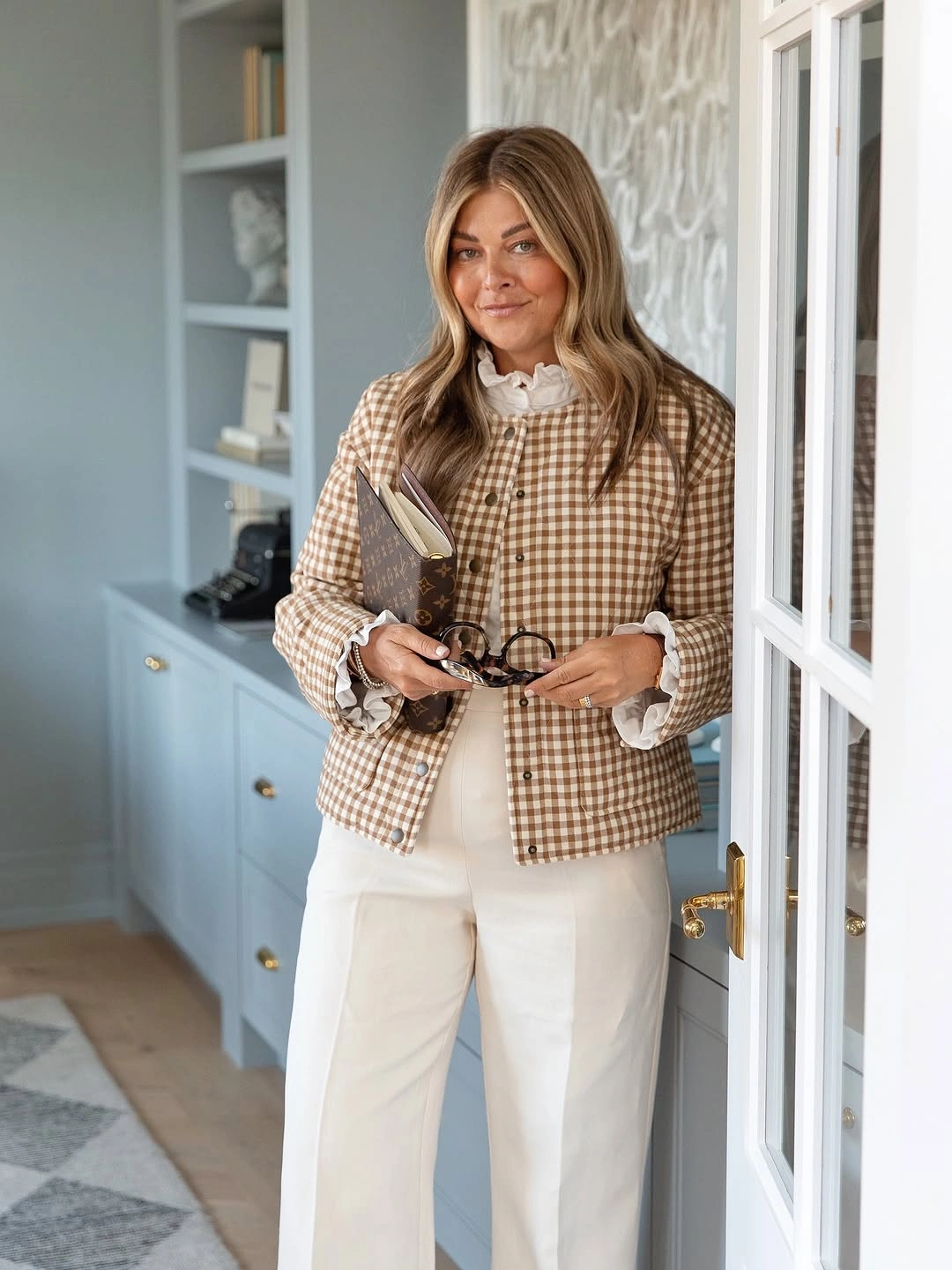
The blouse details soften the straighter shape of the checked layer, especially where the ruffled collar and cuffs extend beyond its edges. That contrast between crisp pattern and softer trim gives the business casual winter look more dimension while staying within a restrained palette. The white trousers then echo the blouse, tying the upper and lower sections together through repeated color.
This combination relies on detail rather than dramatic color contrast to create definition. Pattern, ruffled edges and repeated white areas make the outfit visually distinct while the overall palette remains light and controlled.
Charcoal Blazer With a Light Midi Skirt
A charcoal blazer gives the outfit its strongest tailored line, while a muted purple top introduces a subdued color shift beneath it. The white midi skirt changes both value and movement below the blazer, creating a much lighter lower section than the dark upper half. That contrast makes the jacket feel even more structured without requiring a matching trouser.
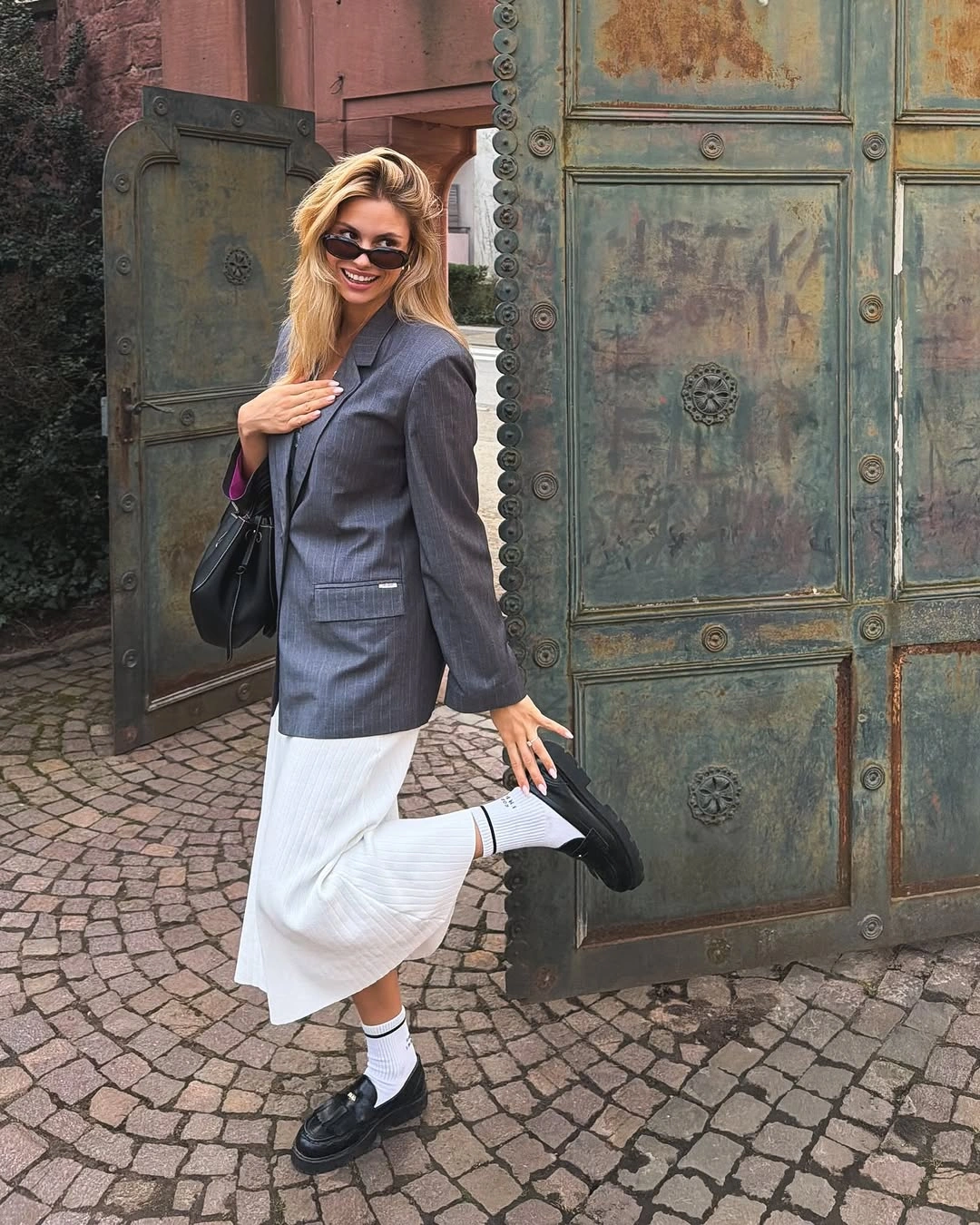
White socks continue the skirt’s light color close to the ankle, but chunky black loafers add enough dark weight to stop the lower half from feeling visually disconnected. A black shoulder bag repeats that grounding tone near the upper body. The result is a winter blazer outfit that balances a softer skirt shape with substantial footwear and compact dark accessories.
The useful contrast here is between tailored structure and a lighter, less rigid lower silhouette. Repeating black in the shoes and bag gives the outfit enough visual weight to connect those different shapes.
Checked Blazer Finished With Burgundy Pointed Shoes
The gray-brown checked blazer, cream top and dark ankle-length trousers form one of the most restrained business casual winter combinations in the set. Each piece occupies a distinct value range, so the outfit is easy to read even without strong color contrast. The blazer’s visible check adds quiet pattern while the cream center keeps the upper half from becoming too dark.
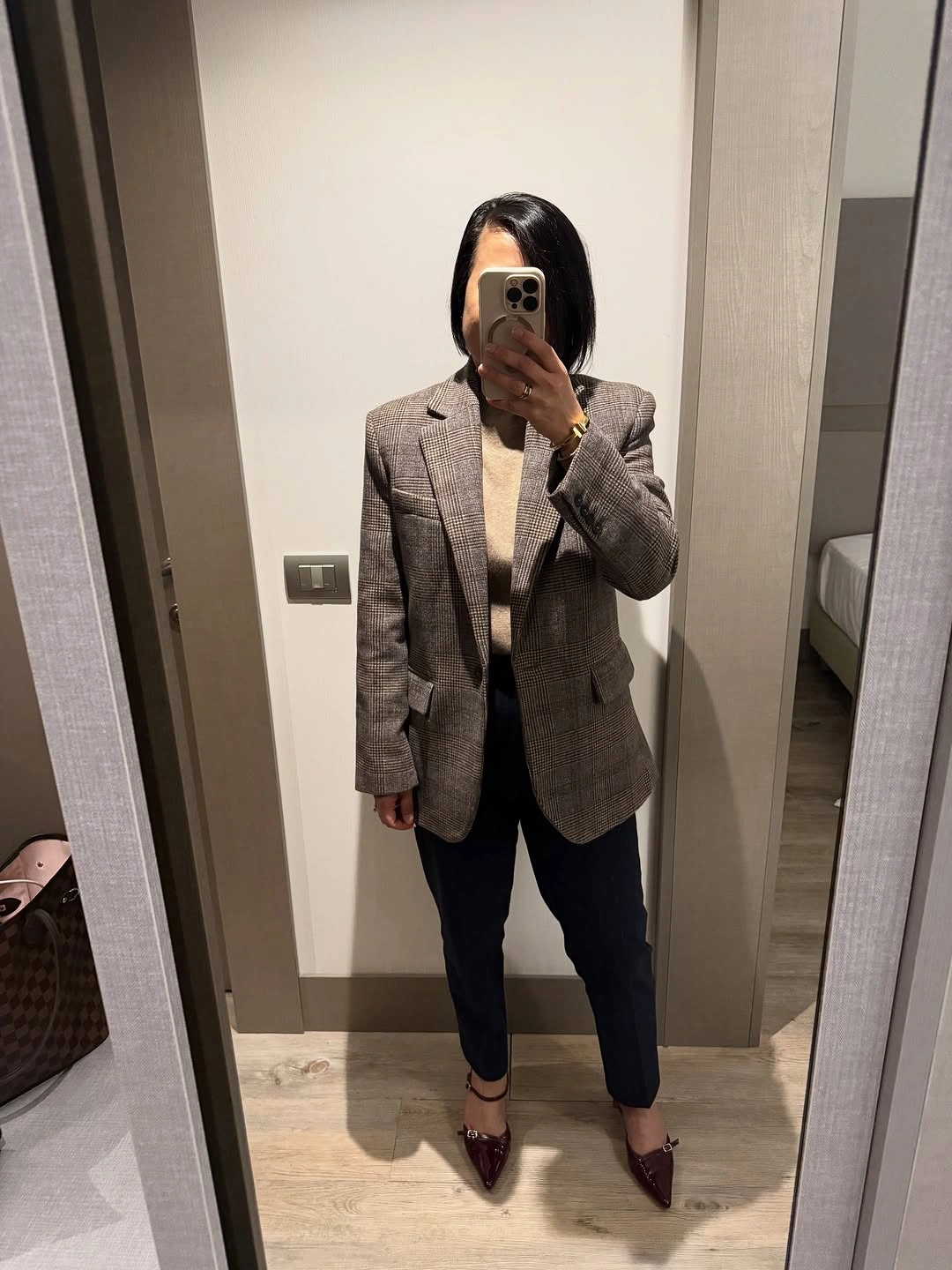
The pointed burgundy shoes are a small but decisive change, adding a deeper red tone at the end of the cropped trouser line. Because the ankles remain visible, the footwear receives more attention than it would beneath a longer hem. That narrow color accent sharpens the otherwise neutral winter blazer outfit and shows how footwear alone can alter the visual finish.
A restrained blazer-and-trouser base leaves room for one concentrated accent to matter. Here, trouser length and pointed footwear work together so a relatively small amount of color becomes an intentional finishing detail.
Graphic Stripes Break Up Dark Winter Layers
A long dark coat and wide black trousers establish an extended vertical frame, while the cream high-neck sweater creates a brighter center inside it. Bold black horizontal stripes cross that lighter area, giving the outfit a graphic interruption without introducing another color family. The contrast stays controlled because every stripe connects directly back to the darker outer pieces.
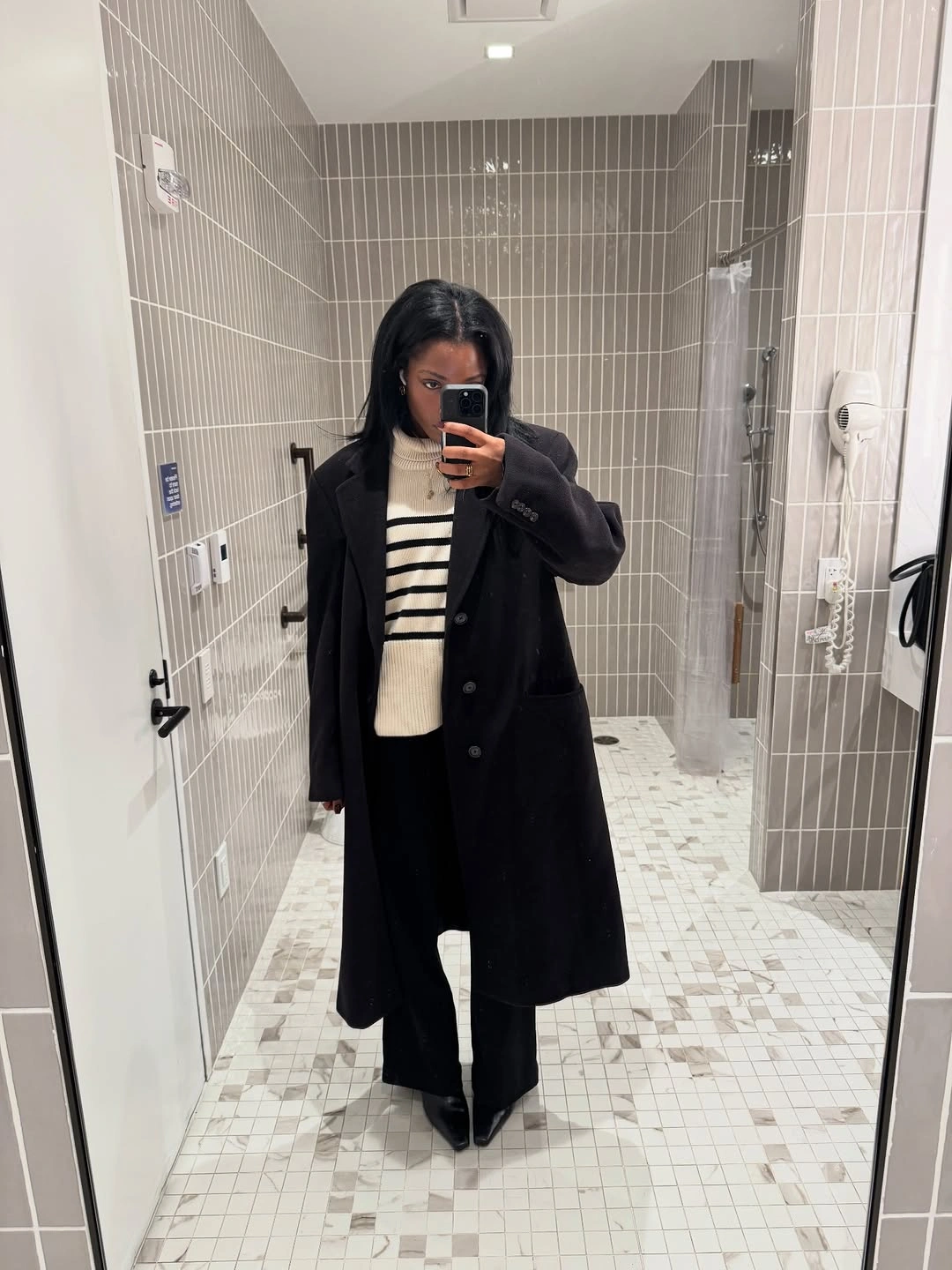
The coat’s length keeps the striped sweater contained between two broad dark sides, so the pattern reads as a focal layer rather than the dominant element. Wide trousers continue the black tone toward the floor and reinforce the long silhouette. For winter business casual outfits, this is a strong example of using one graphic knit to prevent a dark layered look from becoming visually flat.
The pattern works because it occupies a limited central area instead of competing across the entire outfit. Long dark layers around it provide enough visual quiet for the stripes to feel purposeful and clearly defined.
Red Shoulder Layer Sharpens a White Shirt
An oversized white button-front shirt forms the bright center of the outfit, extending past the waist before meeting long black flared trousers. The contrast is simple and graphic, but the red sweater draped across the shoulders changes the balance by adding a broad horizontal band of color high on the body. Its placement makes the upper half feel more defined without covering the shirt’s clean vertical line.
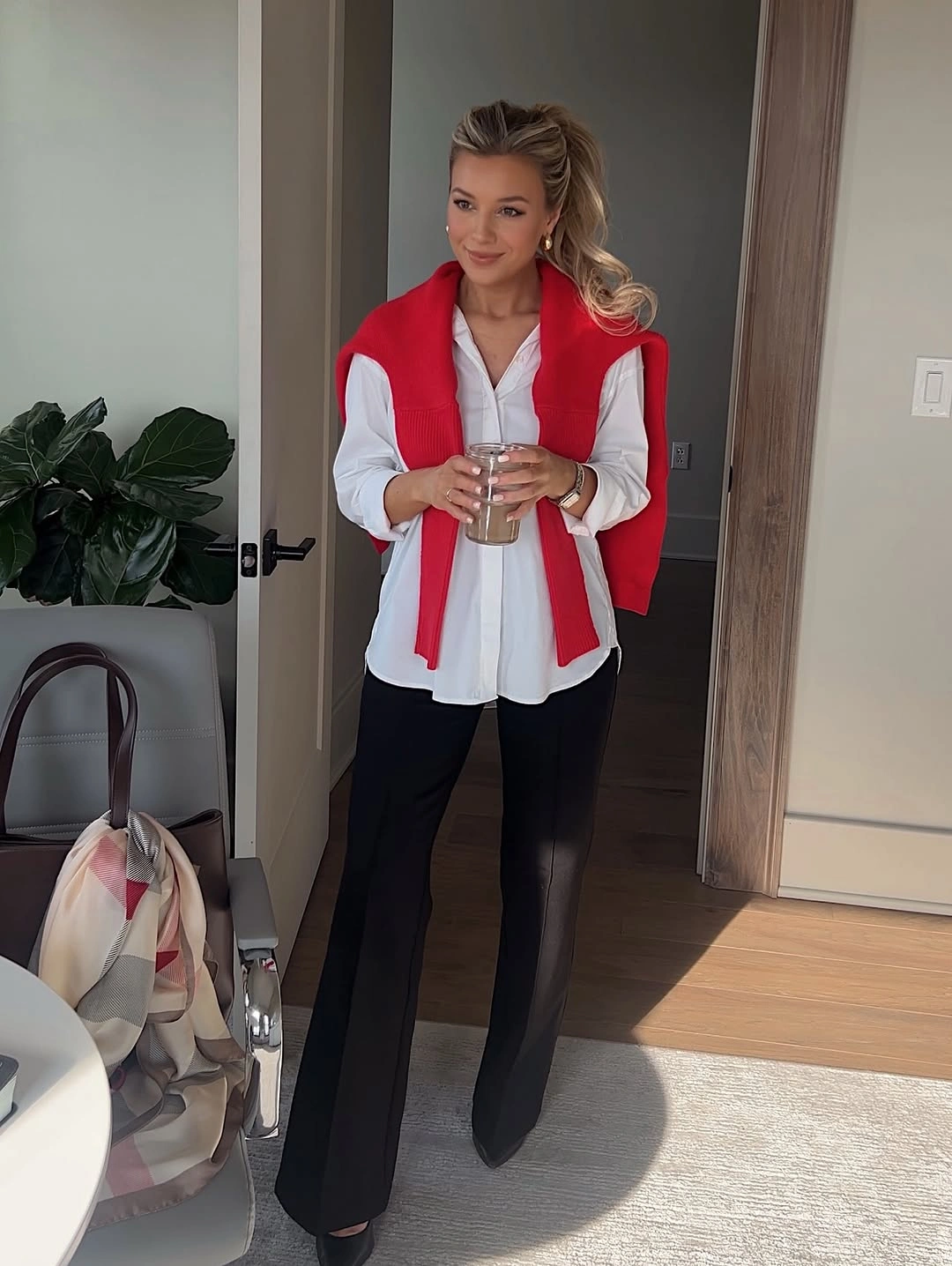
The black trousers create a continuous dark base and widen subtly toward the hem, giving the lower half enough presence to balance the layered shoulders. Pointed black shoes keep that dark line visually connected to the floor. Within a business casual winter outfit, the red layer shows how one concentrated color accent can transform a straightforward white-shirt-and-black-trouser pairing.
The useful idea is to place the strongest color near the shoulders while keeping the rest of the palette restrained. That arrangement draws attention upward and gives a simple base more visual structure without requiring another full outer layer.
Long Brown Coat Frames a Short Black Base
A long warm-brown coat creates the dominant outer line, while the black layer underneath ends much higher and produces a pronounced difference in length. That contrast immediately separates the outerwear from the inner silhouette instead of allowing the pieces to blend together. The coat remains the largest block of color, while the shorter black section keeps the center visually compact.
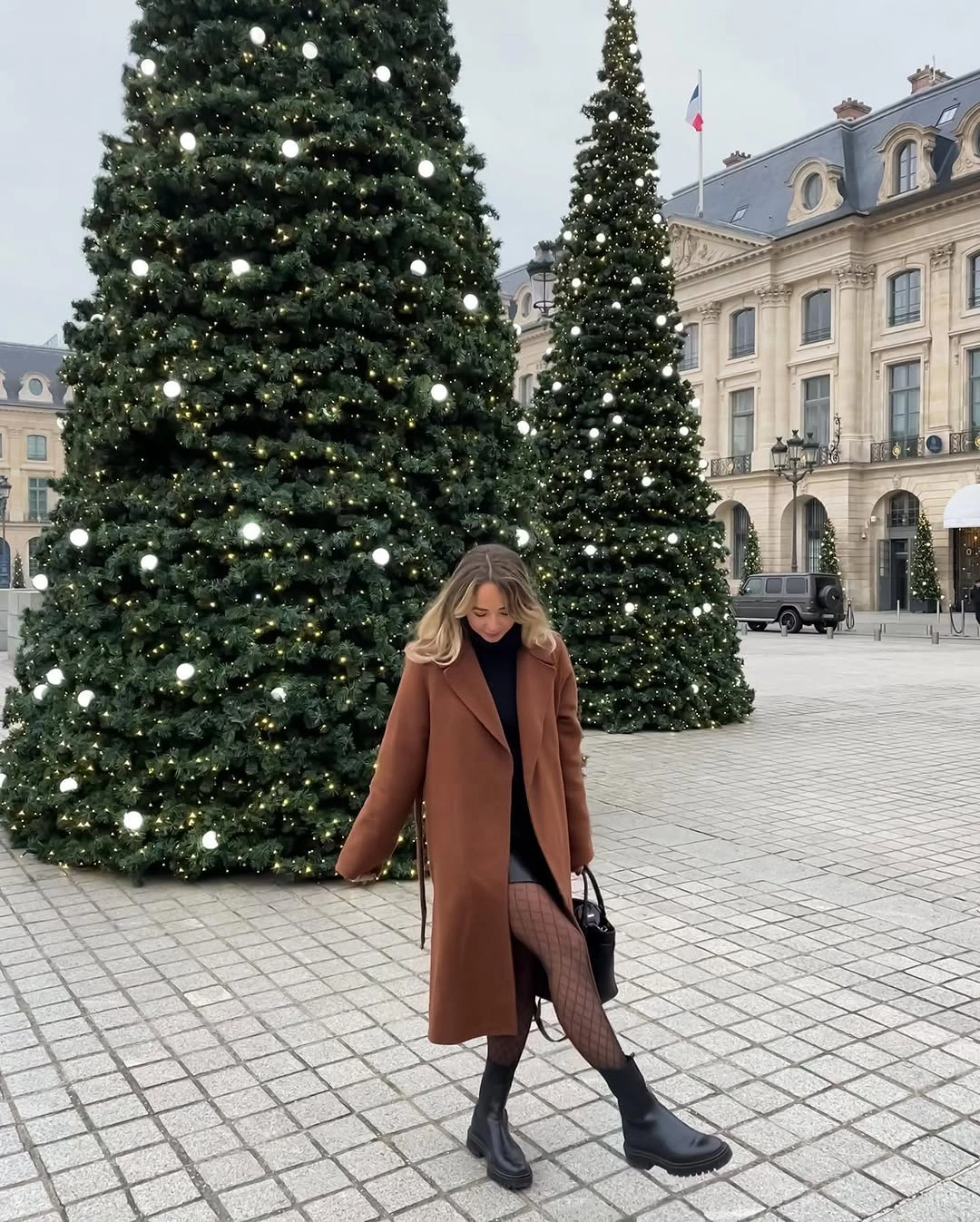
Patterned dark tights bridge the gap between the short black layer and the chunky black ankle boots, preventing the exposed leg area from feeling visually detached from the rest of the outfit. A small black handbag repeats the same dark tone near the upper body. This winter coat outfit uses repetition rather than extra color to connect several different lengths into one coherent composition.
The strongest lesson here is how repeated dark elements can stabilize a large difference between coat length and inner-layer length. Tights, boots and handbag create enough continuity for the long brown outer layer to remain the clear focal point.
Cropped Dark Jacket Meets Wide Black Trousers
A cropped dark jacket with a smooth-looking surface sits high above very wide black trousers, creating a strong change in proportion between the upper and lower halves. The broad brown plush-looking collar and matching cuff accents add noticeable texture around the shoulders and wrists. Because the jacket stops relatively high, the long trouser line becomes even more prominent beneath it.
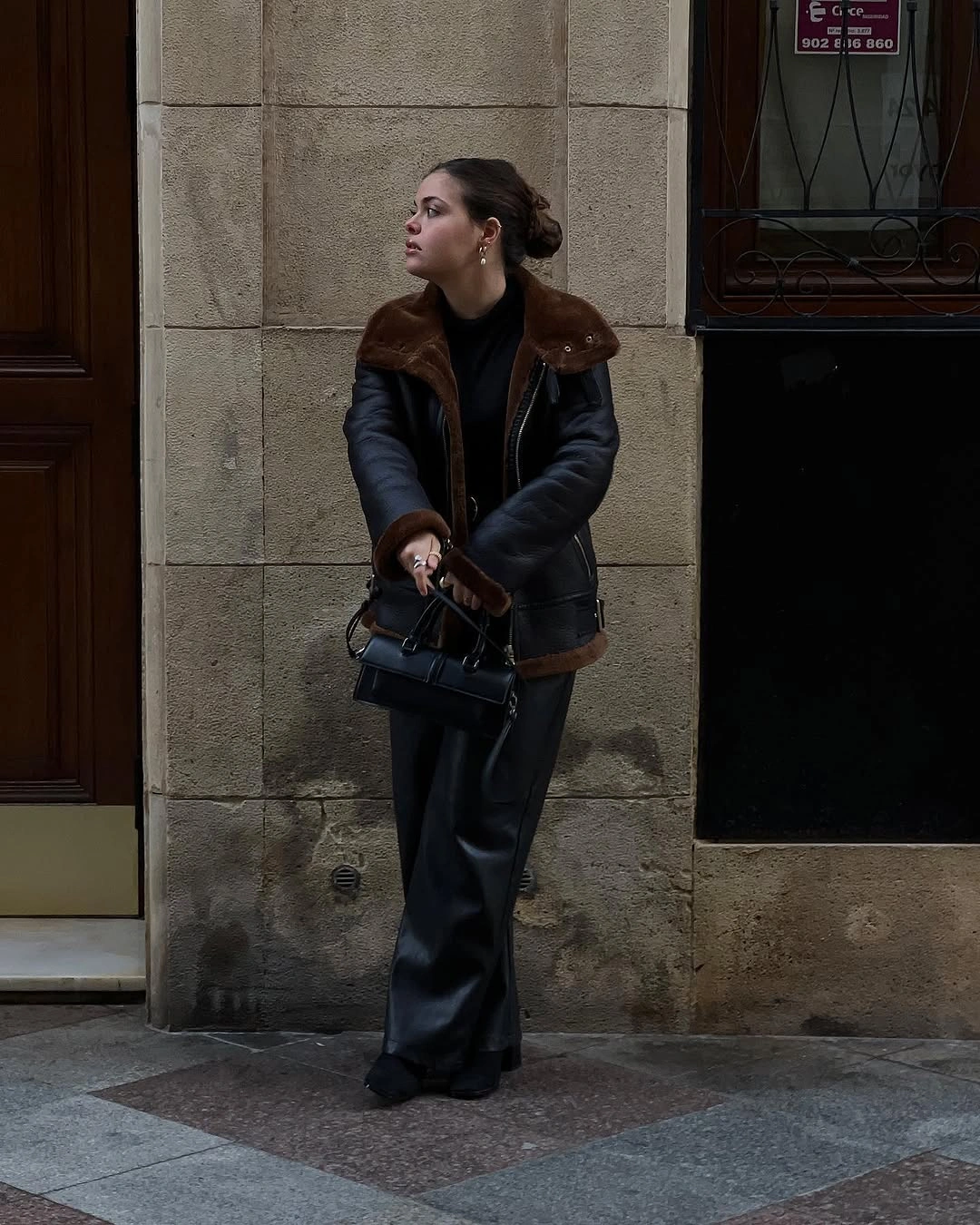
The black top, trousers and structured handbag keep most of the outfit within one deep color range, allowing the brown trim to function as the main contrast. The trousers fall in a broad, uninterrupted column that gives the lower half a cleaner and more elongated appearance than the textured jacket above. That contrast makes the business-casual winter styling feel intentionally mixed rather than visually inconsistent.
The key is the relationship between a compact, textured outer layer and a long, controlled trouser silhouette. Keeping the lower half simple allows the heavier-looking collar and cuffs to add character without overwhelming the overall balance.
Taupe Blazer Makes Relaxed Denim Feel Sharper
A taupe-brown blazer supplies the most structured line in this outfit, sitting over a simple black top and relaxed light blue jeans. The jacket’s straighter shape contrasts clearly with the looser denim below, so the upper half reads as more defined without requiring matching trousers. The muted blazer color also creates a softer transition between black and pale blue than a much darker jacket would.
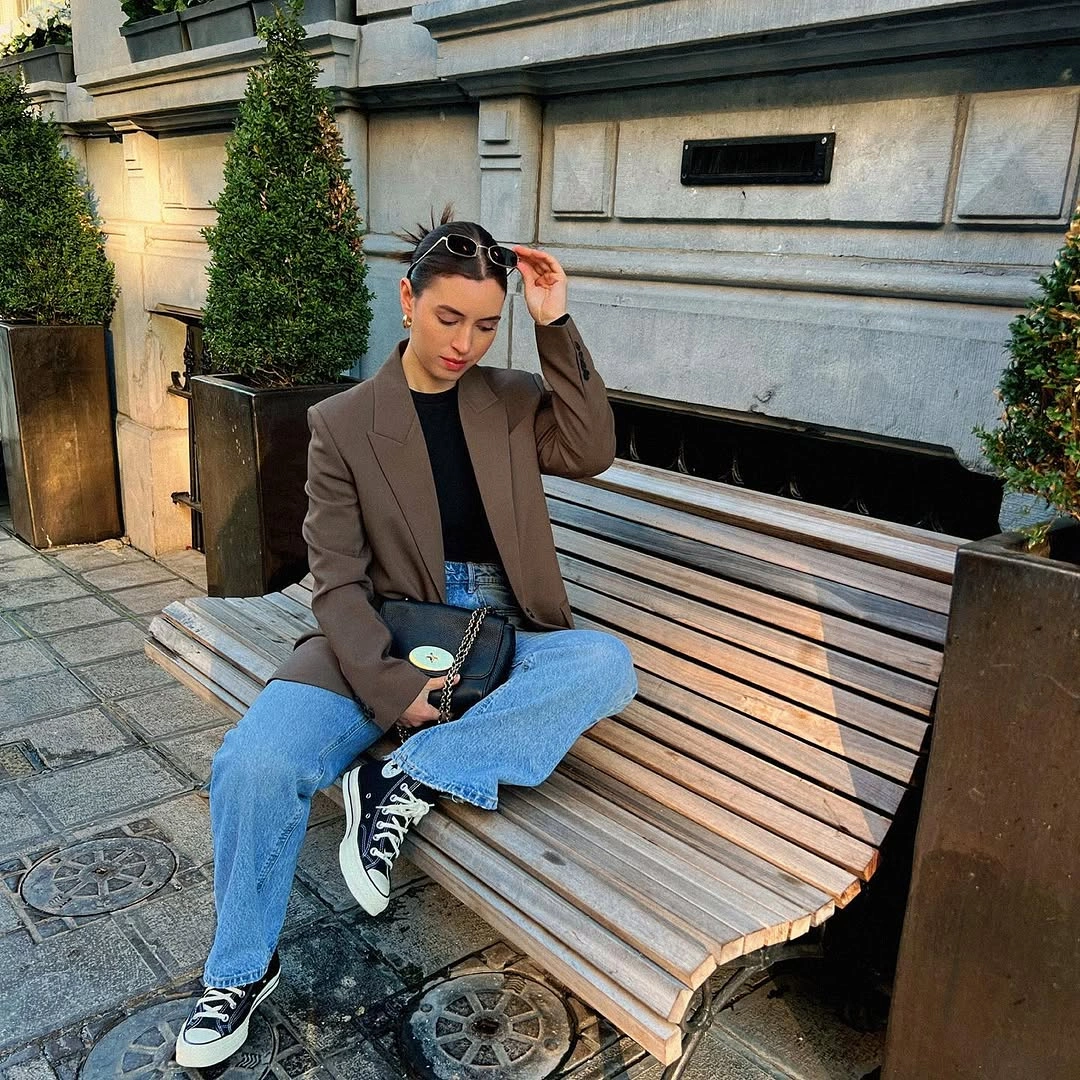
A black belt and small black bag at the waist build a compact dark center that connects the top to the blazer and helps organize the relaxed jeans. Black-and-white low sneakers keep the lower half casual while repeating the darker accents already present above. This business casual with jeans formula depends on one tailored anchor and repeated dark details rather than on a fully coordinated set.
The blazer does most of the work in sharpening the silhouette, while the denim and sneakers deliberately keep the lower half relaxed. That tension between structured and casual pieces gives the outfit its distinct visual identity.
Contrast Trim Defines a Light Sweater Look
A white cable-pattern V-neck sweater dominates the upper half with a bright surface and visibly textured pattern, while narrow black trim around the neckline and cuffs gives those edges crisp definition. The sweater has a relaxed shape, so the dark lines become especially important in controlling its outline. They also provide an immediate visual connection to the fitted black skirt below.
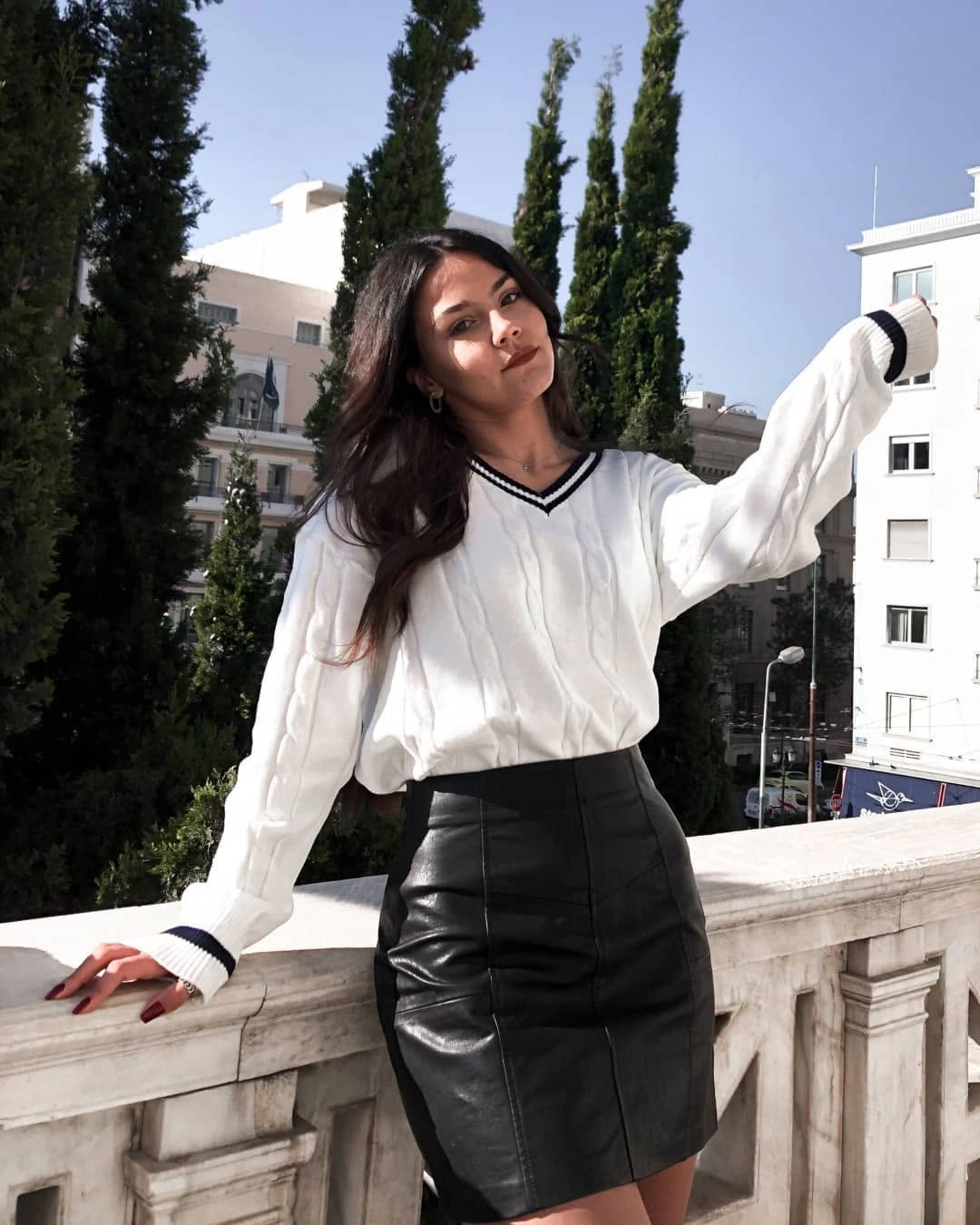
The skirt has a smooth surface with a slight sheen and follows a much closer line than the sweater, creating a clear contrast between softness above and a cleaner, more compact shape below. Because both the neckline trim and skirt are black, the two sections feel linked despite their different textures and proportions. The result is a business casual winter outfit built on repeated edge color rather than additional layering.
This look demonstrates how a small amount of dark trim can organize a much lighter upper layer. Repeating that color in the skirt creates continuity while still allowing the sweater’s cable pattern and relaxed volume to remain the main visual focus.
Pale Long Coat Frames an All-Black Base
A long pale gray coat opens around an almost uninterrupted black base, creating a clear light-against-dark frame from the shoulders to below the knee. The high-neck top and slim trousers stay close in color and line, while tall black boots extend that dark column farther downward. Because the coat remains open, the narrow center stays visible and gives the larger outer layer a precise vertical structure.
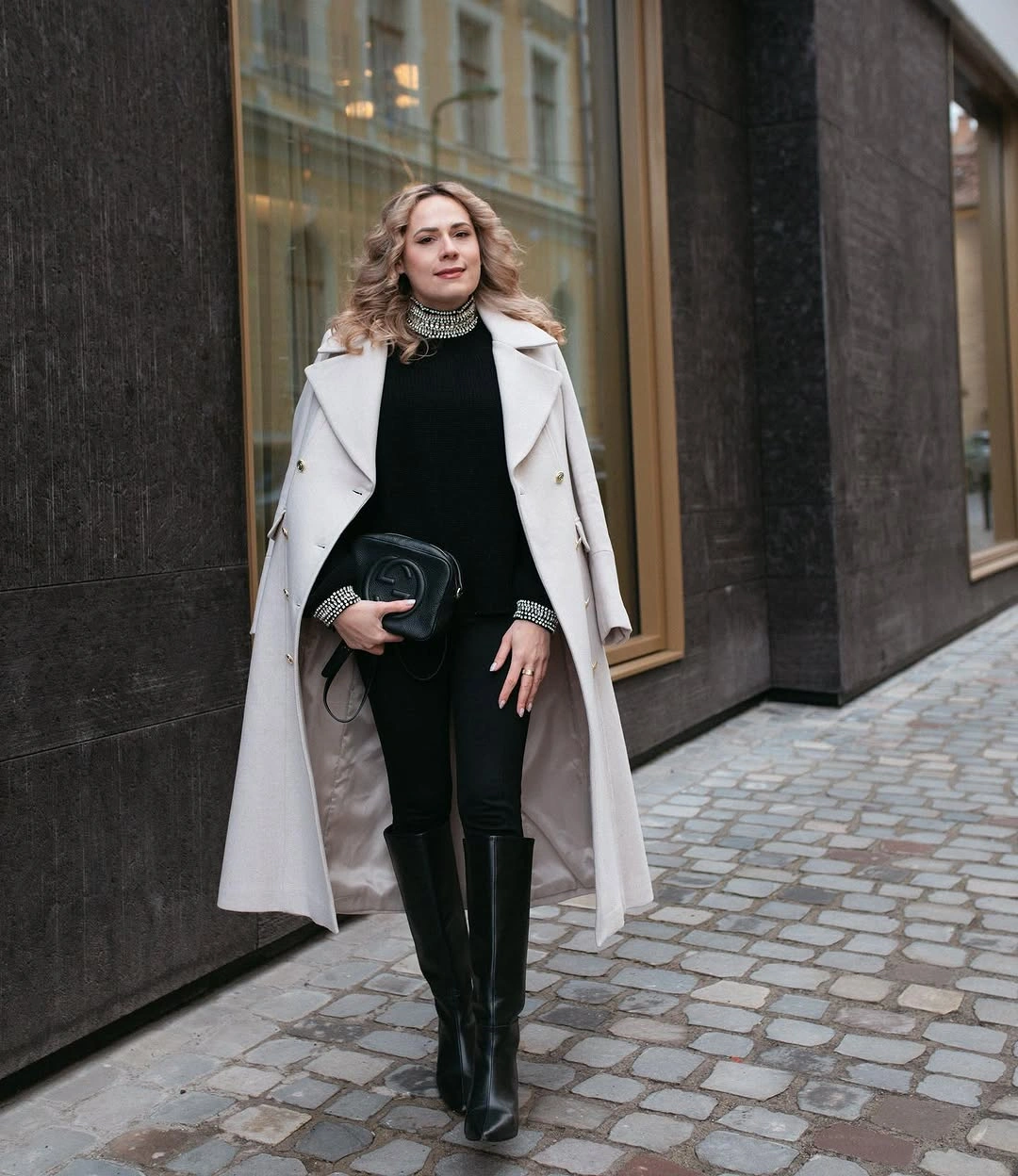
The compact black bag repeats the inner palette without interrupting the long coat line, while the tall boots add visual weight close to the ground. That concentration of dark elements keeps the pale outer layer from feeling detached from the rest of the silhouette. For winter business casual outfits, the combination shows how a single light coat can add width and presence around a restrained monochrome foundation.
The strongest idea is one of framing rather than complicated layering. Keeping the inner pieces consistently dark allows the pale coat to define the silhouette while the boots preserve continuity through the lower half.
Matching Gray Tailoring Softened by Fine Stripes
A gray blazer and matching trousers establish a coordinated foundation, giving the outfit a consistent tailored color from the shoulders through the lower half. Underneath, a white shirt with fine vertical stripes introduces a lighter, more delicate pattern without disturbing that continuity. The visible collar, shirt front and cuffs create narrow bright breaks against the gray and make the layering easier to read.
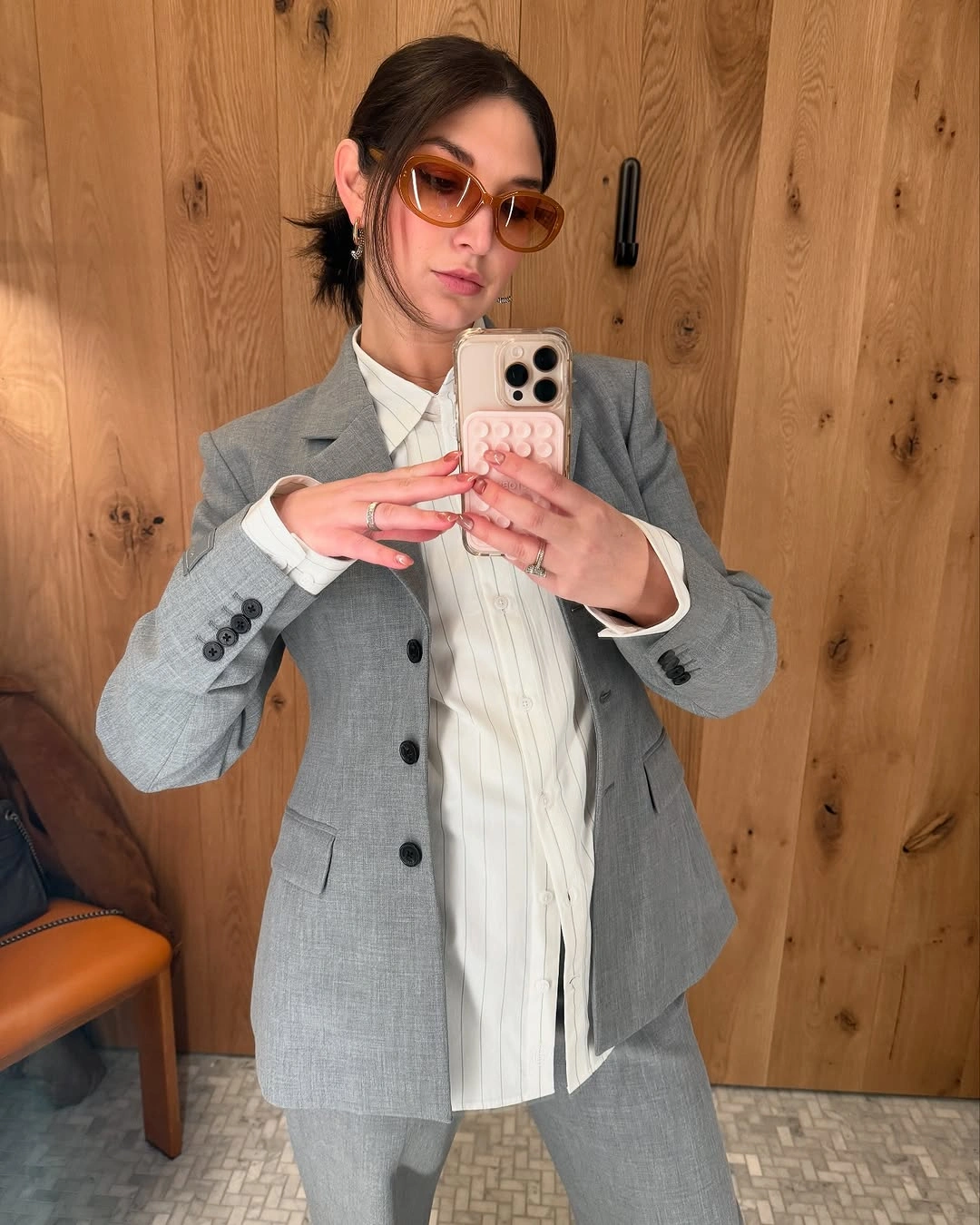
The shirt is less rigid visually than the matching outer pieces because its thin stripes and lighter color bring smaller-scale detail into the center. Oversized amber-toned sunglasses add another distinct accent near the face without changing the restrained gray-and-white palette below. This winter blazer outfit shows how a coordinated set can feel less severe when a patterned shirt supplies contrast through line rather than bold color.
Matching pieces provide immediate visual order, but the shirt keeps that order from becoming overly uniform. Fine stripes and crisp white edges add just enough variation to separate the layers while preserving the clean business-casual structure.
Ornate Dark Jacket Meets Relaxed Blue Denim
A dark jacket with ornate gold-toned detailing across the upper area creates the strongest visual statement, while a white ruffled blouse brightens the center with a softer, more decorative shape. The ruffles extend vertically along the front and around the neckline, so the pale layer remains clearly visible beneath the darker outer piece instead of disappearing into the surrounding detail.
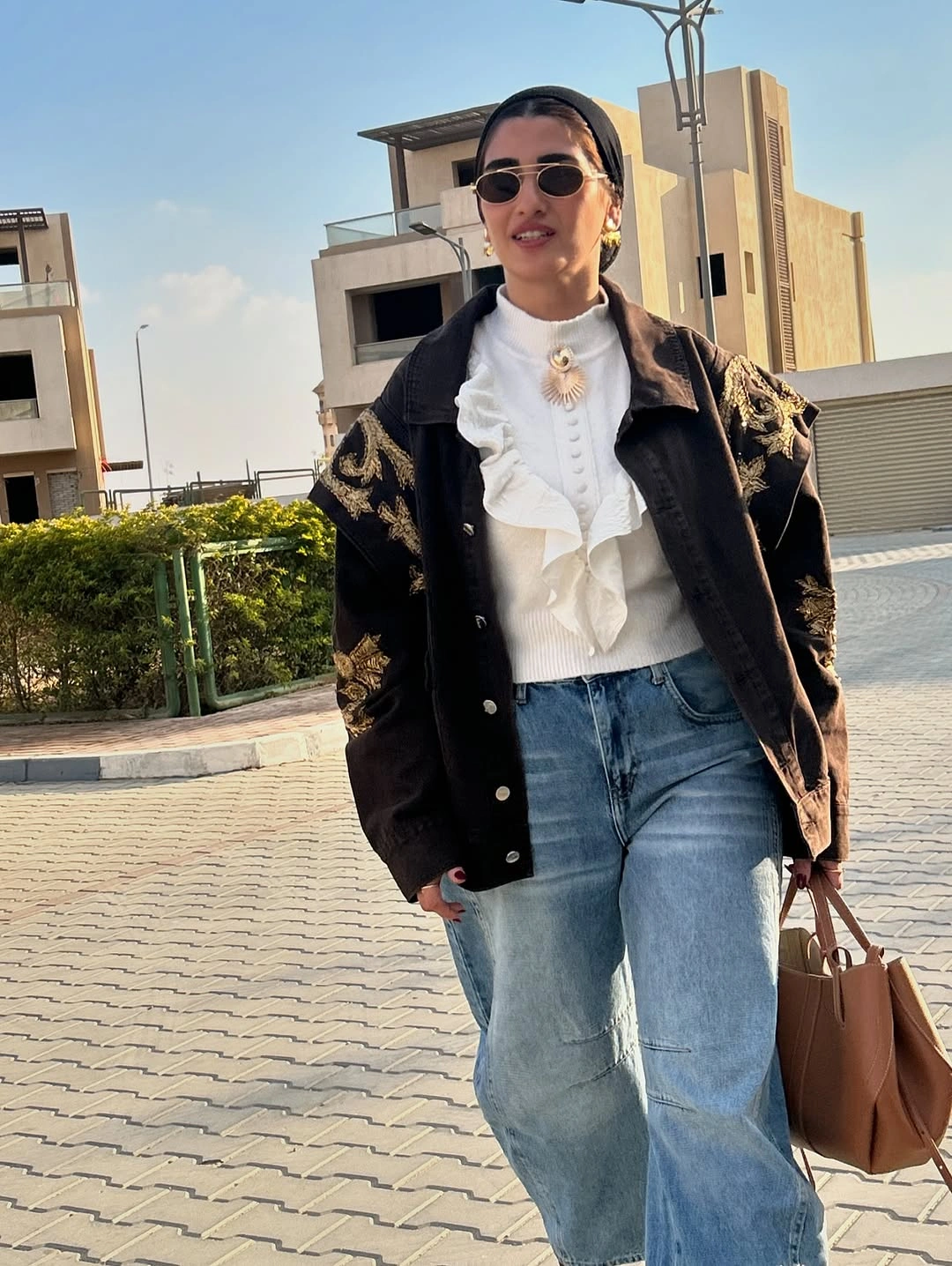
Relaxed light blue jeans shift the lower half toward a more casual proportion, creating a deliberate contrast with the elaborate jacket and crisp white blouse above. A structured brown handbag introduces another grounded neutral without repeating the black of the jacket. As a business casual with jeans formula, the look relies on upper-body detail to sharpen denim rather than using a conventional blazer.
The outfit works through contrast between decorative structure above and looser simplicity below. Keeping the jeans visually uncomplicated gives the detailed jacket and ruffled blouse enough space to remain the main focus.
Charcoal Layers Sharpened by a White Collar
A long charcoal double-breasted coat sets a deep tonal foundation, while the dark sweater underneath keeps the center close to the same value instead of introducing another large color block. The crisp white shirt collar becomes the sharpest point of contrast near the face, with a small amount of white also visible lower down. Those limited bright areas keep the layered grays from merging completely.
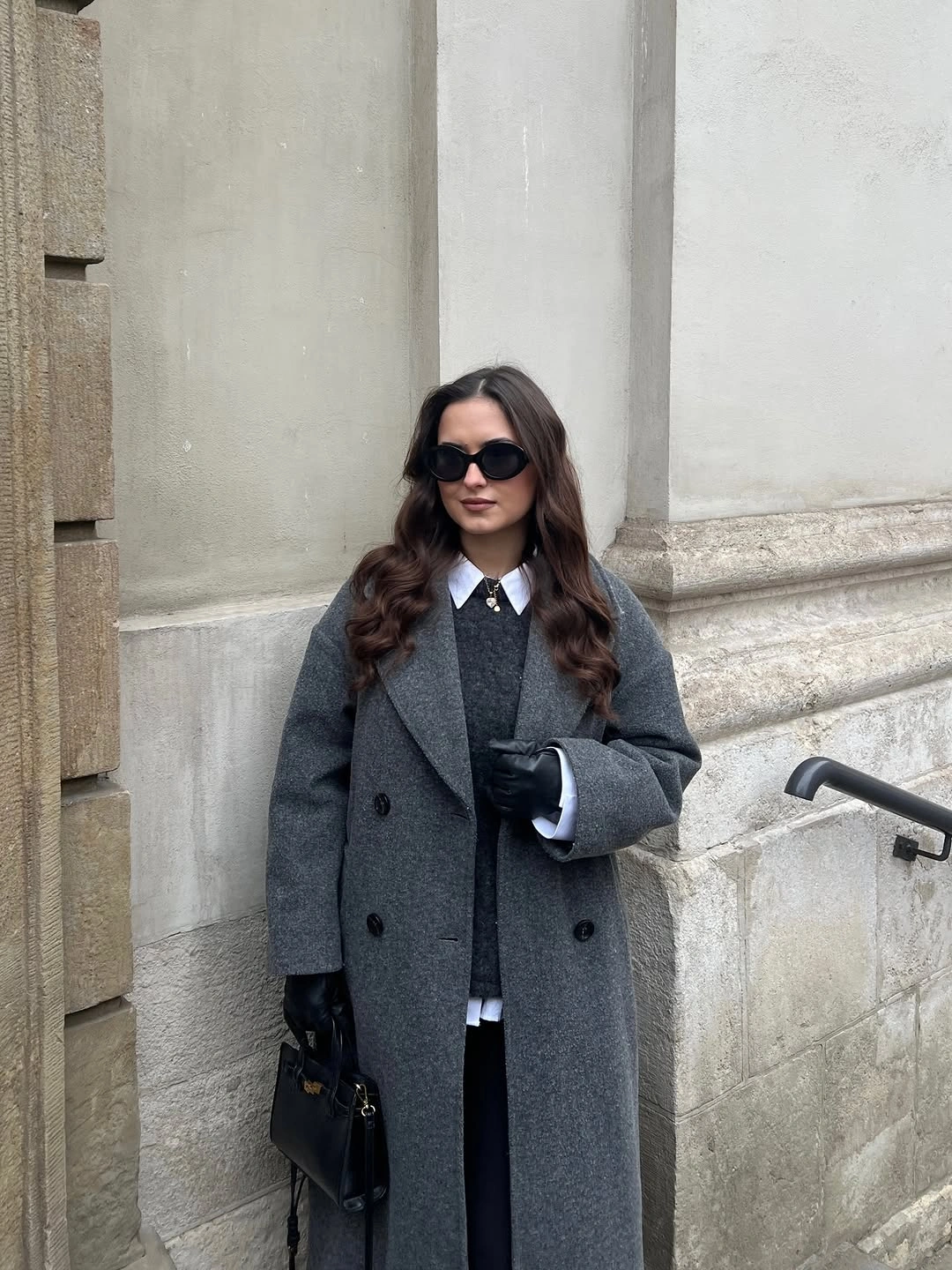
Black gloves, sunglasses and a structured black handbag deepen the palette around the coat without competing with its long shape. Because nearly every major piece stays within charcoal, gray or black, the white collar becomes unusually important as a precise visual separator. This is a restrained example of winter business casual dressing where minimal contrast carries more impact than multiple colors or patterns.
Only a small amount of white is needed to give the dark layers definition. The look demonstrates how a crisp collar can sharpen a tonal coat-and-sweater combination while allowing the long charcoal silhouette to remain dominant.
Camel Outerwear Warms Up Dark Denim
A short camel-brown coat sits over a chunky cream turtleneck, concentrating most of the lightness and visible volume around the upper half. Below, dark indigo wide-leg jeans create a much deeper block of color and extend the silhouette with a broader trouser line. The difference between warm neutrals above and dark denim below gives the outfit a clear two-part structure without requiring a blazer.
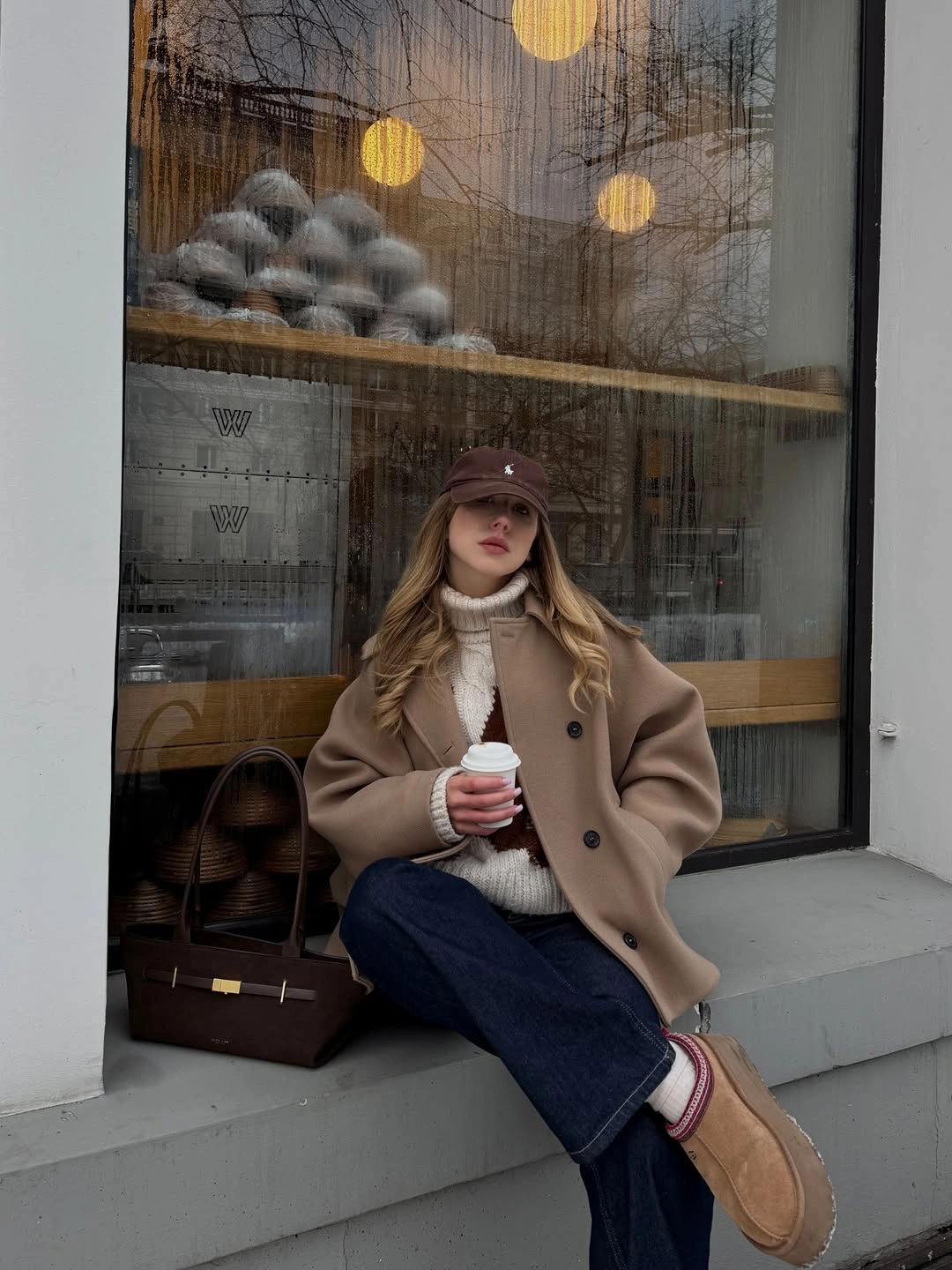
A brown cap, large brown handbag and tan ankle boots repeat related tones in several smaller areas, helping the upper palette travel through the rest of the outfit. The boots have a soft matte-looking surface, but no specific material needs to be assigned to them. This business casual with jeans approach uses repeated brown accents to organize the look while the dark denim provides the strongest visual contrast.
Repetition is doing more work here than strict color matching. Echoing brown across the coat and accessories creates continuity, while the cream neckline and dark jeans prevent the outfit from becoming one uninterrupted neutral block.
Belted Cape Shape With Deep Burgundy Accents
A muted mauve-brown cape-like wrap layer creates the widest silhouette in this final group, with draped sleeves spreading outward before the self belt draws the shape back in at the waist. Plush-looking accents at the cuffs add another visible change in surface near the hands, while the long upper layer keeps its color and volume concentrated above the slimmer dark trousers.
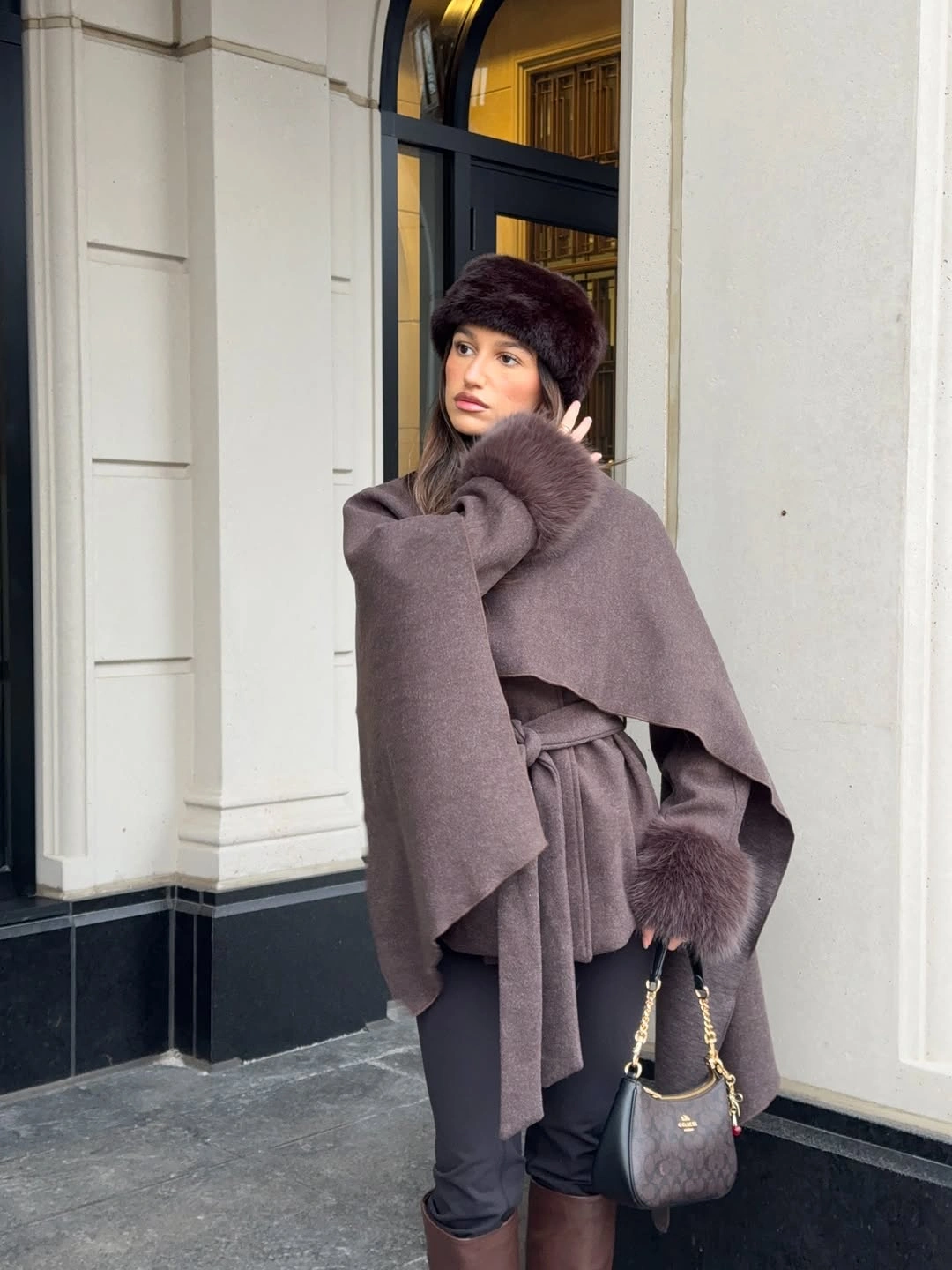
The dark burgundy hat extends the brown-red color family upward, while a small structured handbag adds a compact shape against the broader draped outer layer. Slim dark trousers narrow the silhouette below the belt and prevent the upper volume from continuing all the way to the ground. For a business-casual winter look, that wide-to-narrow progression gives the outfit a deliberate sense of proportion.
The key idea is that structure does not have to come from blazer seams or a straight coat. Here, the tied waist and slim lower half give a dramatic draped shape enough definition to feel visually controlled.
Cropped Plush Jacket Over a Narrow Black Base
A cropped pale gray-and-white jacket with a fur-like surface creates a broad, highly textured upper shape, while the fitted black high-neck top underneath establishes a much narrower center. Slim black trousers continue that dark line downward, so the contrast between the pale outer volume and the uninterrupted black base becomes the defining feature of the silhouette.
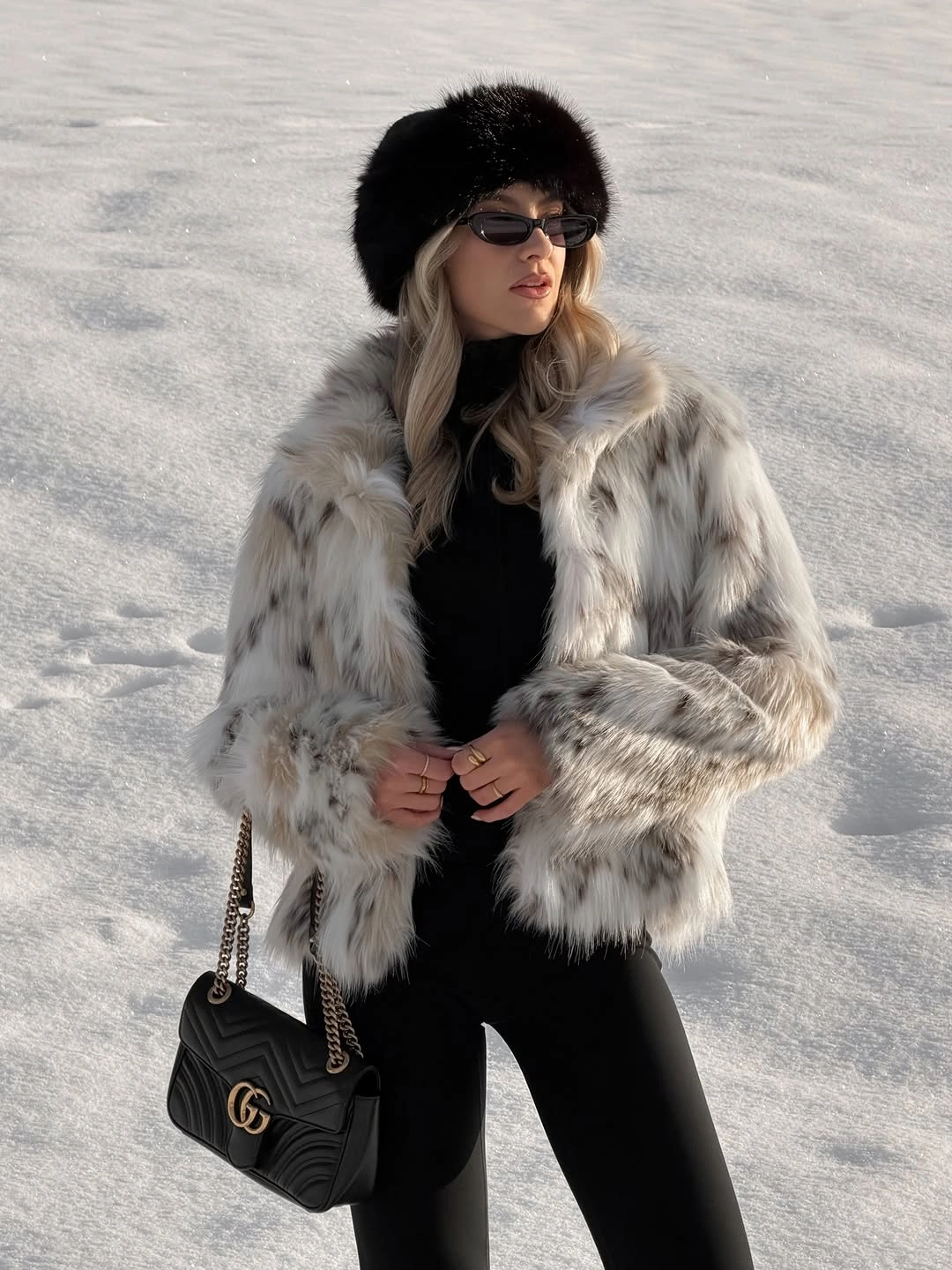
A black fur-like hat, dark sunglasses and a chain-strap bag repeat the black palette around the upper body, keeping the pale jacket isolated as the main light element rather than allowing it to feel disconnected. Because the outer layer ends high, the long narrow base remains especially visible. This winter coat outfit uses concentrated texture above and visual restraint below to maintain balance.
Cropped volume becomes easier to read when the pieces underneath stay close in color and proportion. The dark base gives the pale textured jacket room to remain dramatic without letting the overall silhouette lose its vertical continuity.
Fuzzy Brown Cardigan With a Crisp White Collar
A dark brown button-front cardigan with a fuzzy visible surface forms the main outer layer, while a crisp white pointed collar creates a small but precise break at the neckline. The cardigan’s softer-looking texture contrasts with the cleaner collar shape, giving the upper half definition without a blazer or long coat. Black trousers keep the lower section simple and visually grounded.
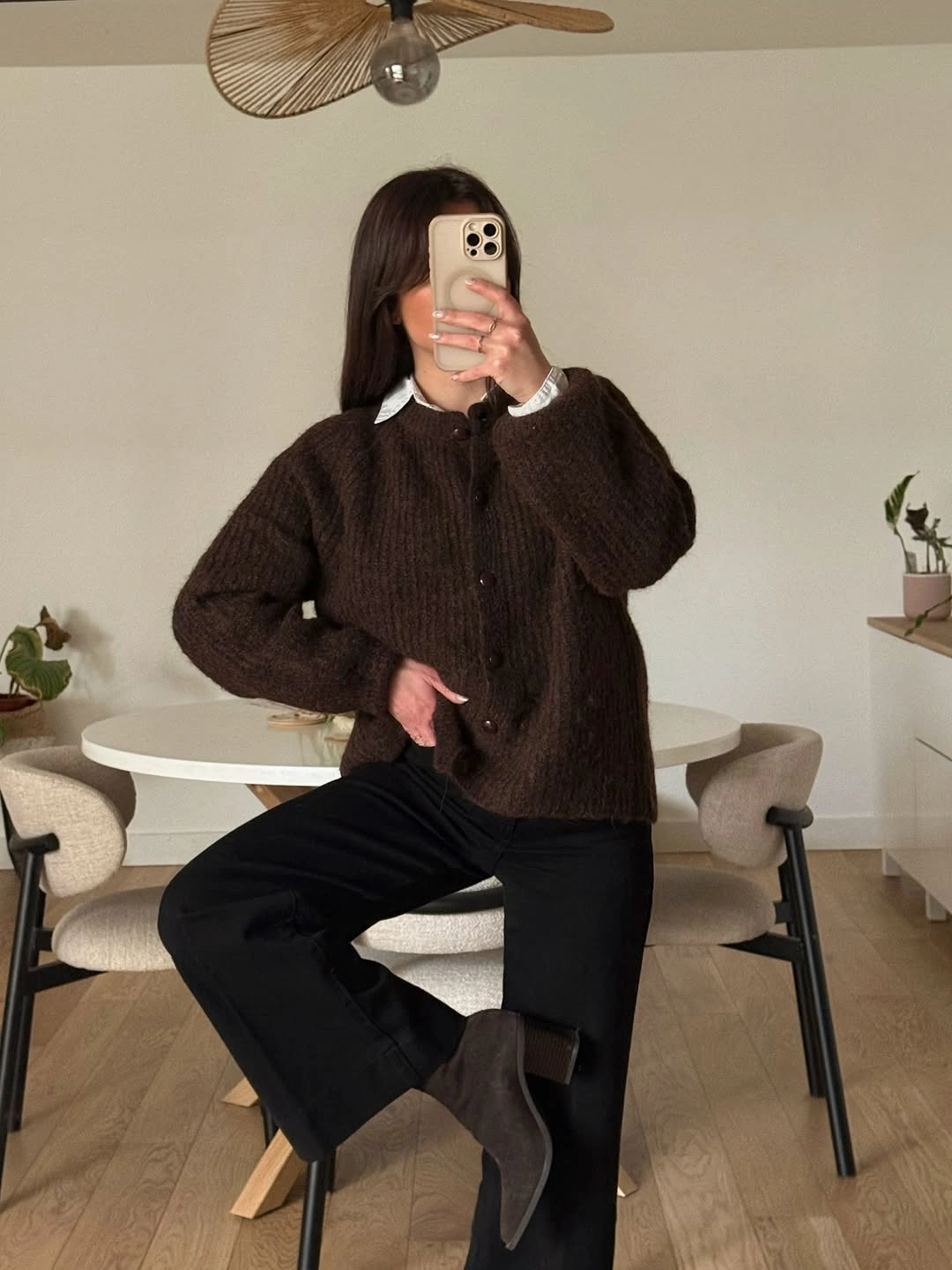
Dark brown ankle boots echo the cardigan without matching the black trousers exactly, creating a subtle return of the upper color near the floor. Because the palette stays limited to brown, black and white, the pointed collar carries more visual importance than its small size might suggest. This winter business casual outfit shows how a textured cardigan and one sharp light detail can create an orderly finish.
The final look reduces the formula to a few clear elements instead of relying on dramatic outerwear. A soft textured layer, crisp collar and restrained dark base are enough to create visible contrast and a polished sense of proportion.