
Fall Nails for Brown Skin Tone: Rich Color and Shape Ideas
A shade can look overly sweet on a swatch and still land with confidence once the neutral space around it changes. On brown skin, a pale center can make a bright edge feel crisp, while a deep wine tone can turn almost velvet-dark until its red warmth catches the light. The useful tension is not bright versus muted; it is how much color the eye can hold before the shape loses its quiet base.
For fall nails for brown skin tone, choose the strongest color by checking where the contrast begins and whether the surrounding base gives it room to breathe. A clean edge usually matters more than adding another accent, and the right length should support the design instead of making upkeep the main event. If a shade feels too loud, reduce its area or soften its undertone before abandoning the idea.
Bright tip colors on a soft almond base
The first manicure makes a clear color decision: long almond nails stay pale and glossy through the center, then finish with tiny curved tips that shift from red and yellow to green and blue. Because the tip placement repeats even when the colors change, the set feels organized rather than random. The dark skin around the nails also gives every small edge enough contrast to remain visible.
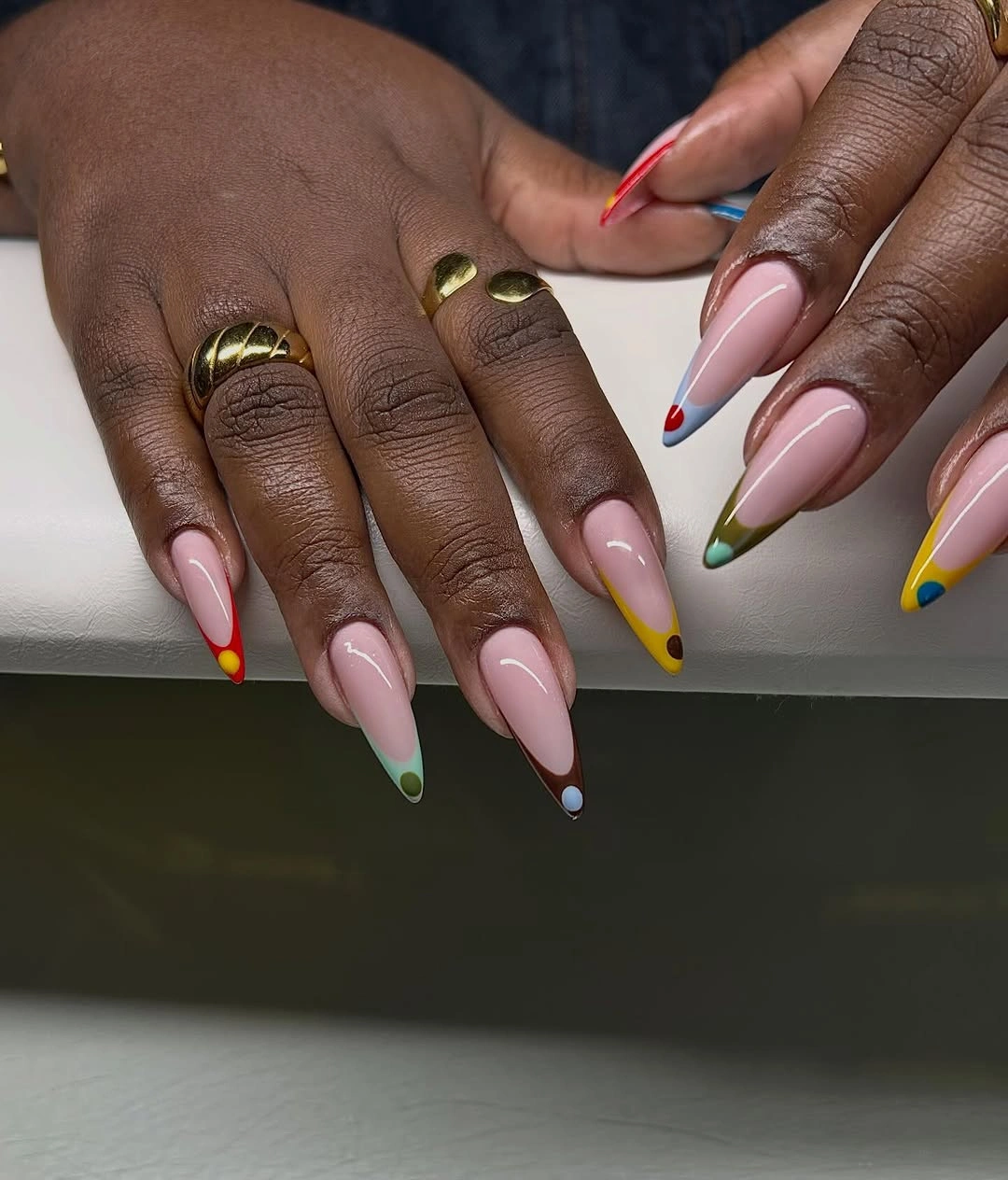
This is a strong way to make fall nails for brown skin tone feel playful without covering the whole nail in art. The neutral pink space keeps the look breathable, while the thin colored ends create a quick rhythm from finger to finger. A shorter almond or soft oval would preserve the idea, although the colors would need slightly more spacing so each tip does not blur into the next.
The most practical adjustment is to keep the repeated tip shape and reduce the palette to three shades. Red, muted yellow, and deep green would lean richer for autumn, while a blue accent could remain the fun option on one nail. The long taper is part of the effect, but it also means the fine edges and pointed corners will need more attention as they grow out.
Glossy wine color with no extra decoration
A compact burgundy manicure proves that a single dark shade can carry plenty of seasonal weight. The nails are rounded and short to medium in length, and the glossy wine surface moves from red-brown highlights to nearly black edges. With no art competing for attention, the even curve and clean cuticle line become the details that make the color look intentional.
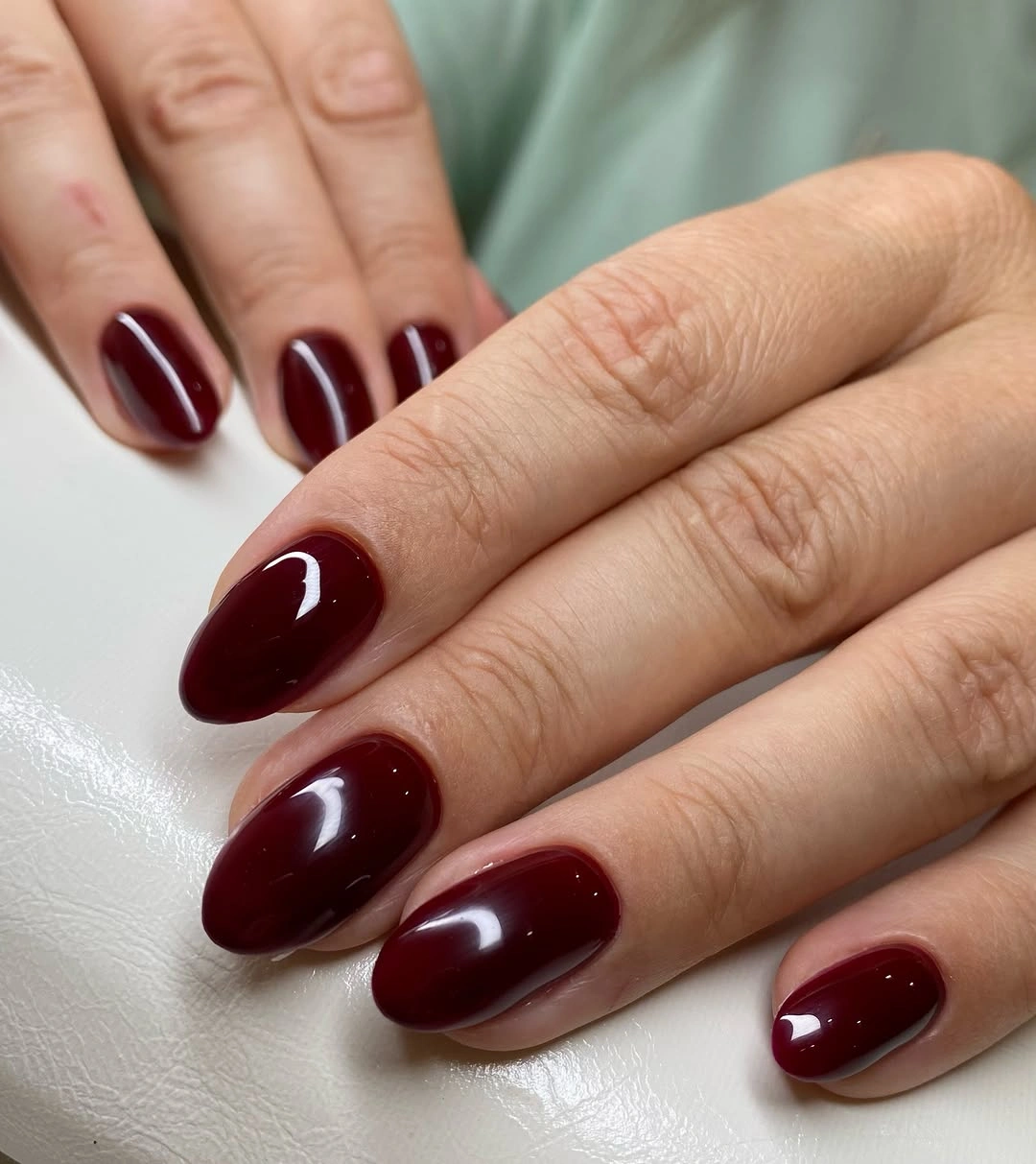
The simplicity works especially well when the shade is allowed to stay saturated. On brown skin, the red undertone prevents the color from disappearing into the background, while the reflective finish keeps it from feeling flat. If you like the depth of dark fall nails but want a softer outline, a rounded squoval would give the same mood with a little less visual intensity.
This design is also the easiest to shorten or repeat because it does not depend on a motif or a precise tip. The tradeoff is that chips show quickly against a dark glossy surface, so the manicure benefits from tidy edges and prompt repairs. A slightly warmer brown-red would make it gentler, while a cooler wine would sharpen the contrast without adding decoration.
Brown framed tips and tiny gold punctuation
Here the pink base is not left plain: medium-long square nails use dark brown along the free edges and side lines, with small gold points placed on selected nails. The brown acts like a graphic frame instead of a full coat, so the soft center still shows through. That contrast gives the angular shape a more decorative feel without filling every available space.
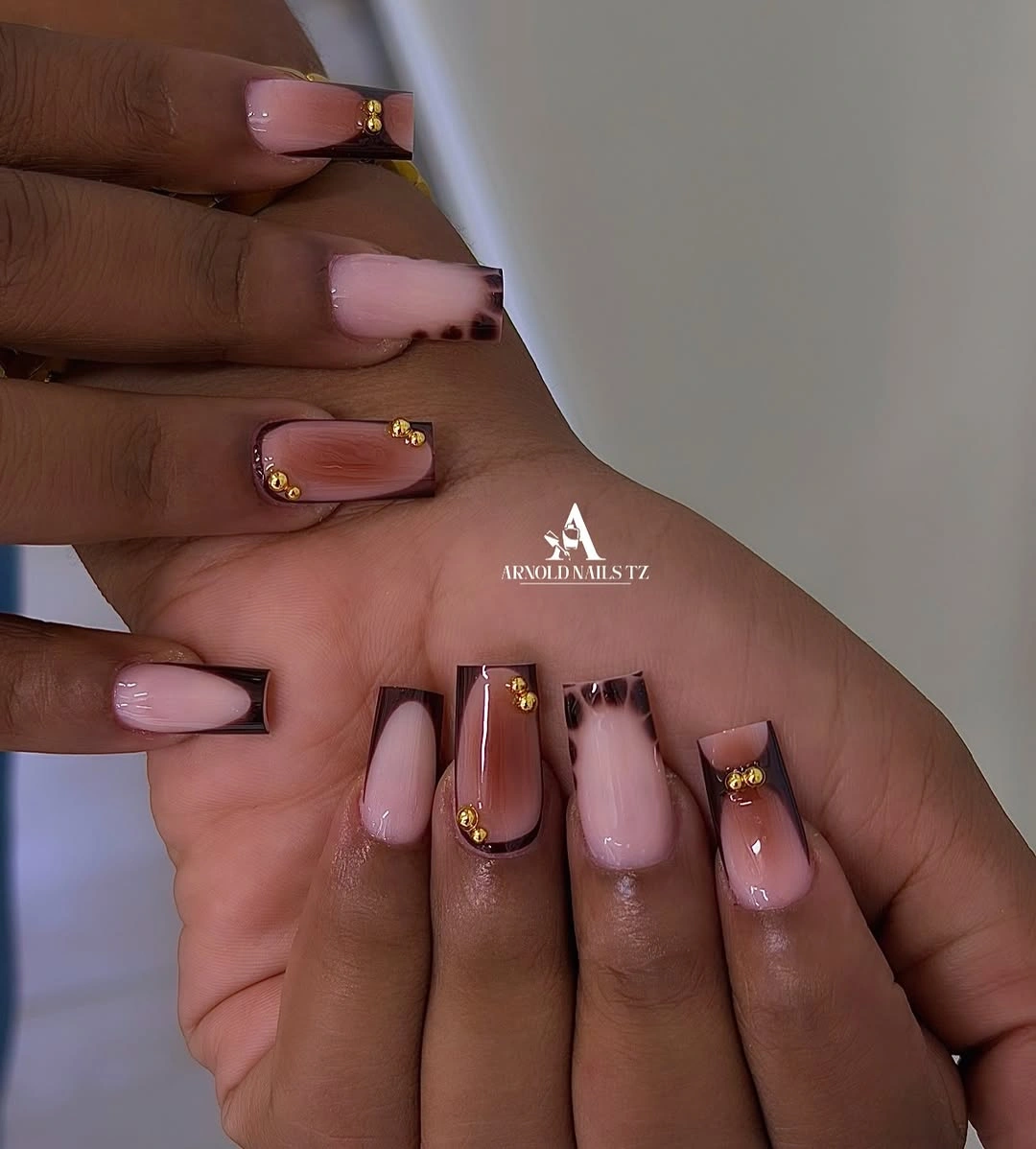
The set works because the gold details repeat lightly while the brown keeps the palette connected. The squared corners bring structure, and the small warm accents stop the dark edge from reading too severe against the pink base. A shorter squoval could keep the same idea with one brown edge and one gold point on each hand, making it easier to wear without losing the graphic border.
There is a real balance decision here: more studs and thicker brown lines would make the manicure louder, while fewer accents would move it toward a clean French design. For an autumn-friendly version, keep the base sheer and shift the brown toward espresso. The long square length and tiny embellishments are the parts most likely to affect everyday comfort, so simplifying those is more useful than merely changing the shade.
Classic white tips with a high-contrast base
Medium-long square nails with a pale pink center and crisp white tips create the clearest classic French moment in the group. The white edge is broad enough to read immediately, but the center remains translucent-looking and calm. Against dark skin, that pale boundary has strong definition, which lets the shape look polished without relying on extra art.
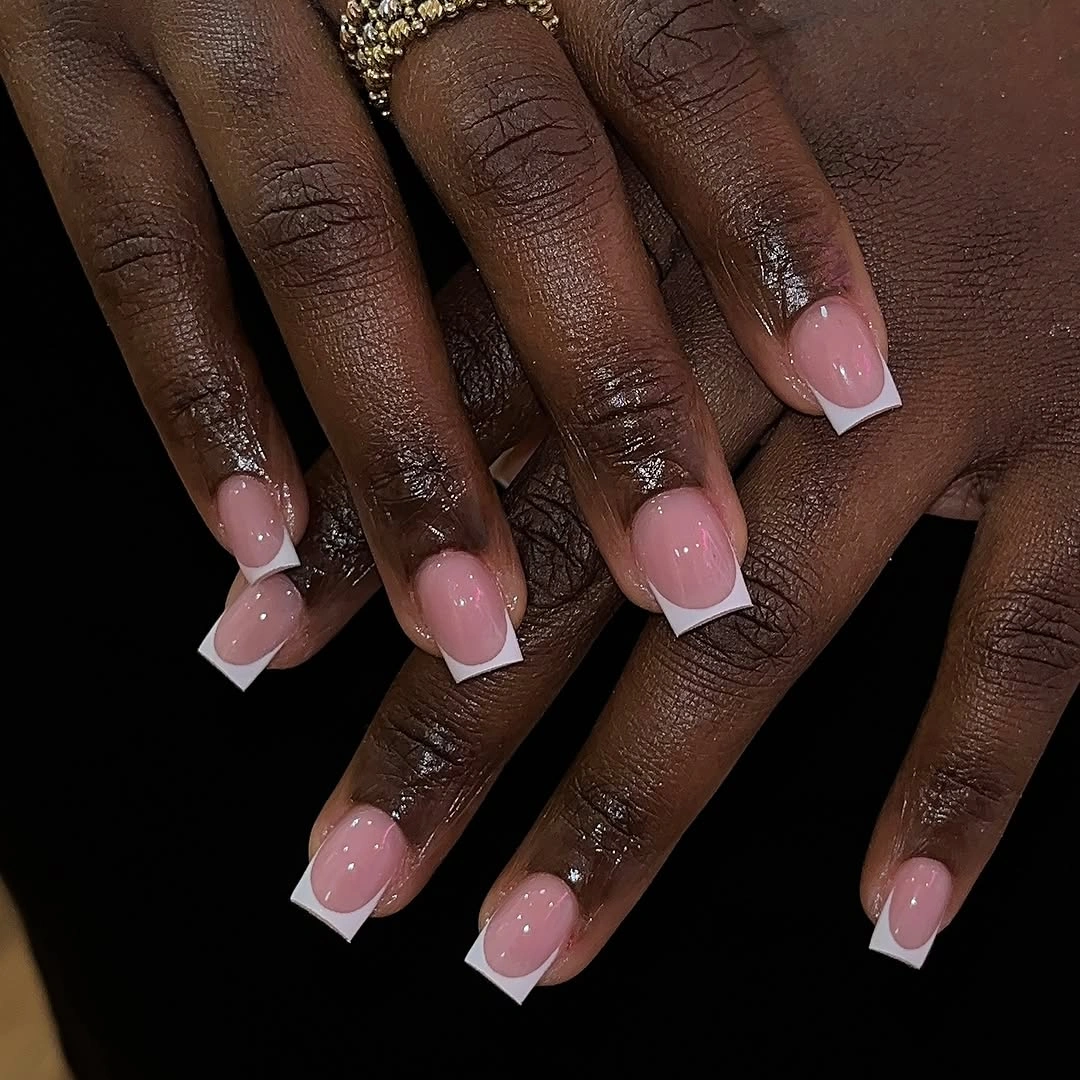
The clean contrast is useful when you want fall nails on brown skin tone that feel seasonal through shape and finish rather than through an obvious motif. A shorter squoval would keep the same proportion, and a slightly warmer pink center could make the transition feel softer. The white tip is the focal point, so its curve matters more than adding another color. That same restraint is useful when comparing these fall French nails and deciding how much of the tip should stay visibly open.
White edges also come with an honest limitation: marks, uneven growth, and small chips stand out sooner than they would on a deep shade. That makes this a design worth choosing when you enjoy regular upkeep and a very clear outline. If that level of contrast feels too sharp, keeping the white only on two accent nails gives the hand more visual breathing room.
Muted mauve lets the almond shape lead
This medium almond set uses one glossy muted mauve-pink shade from nail to nail, so the color stays quiet and the taper does the talking. The surface is smooth, with no visible art to interrupt the rounded silhouette. A floral ring sits nearby, but the manicure itself remains a clean solid that depends on undertone, length, and reflection.
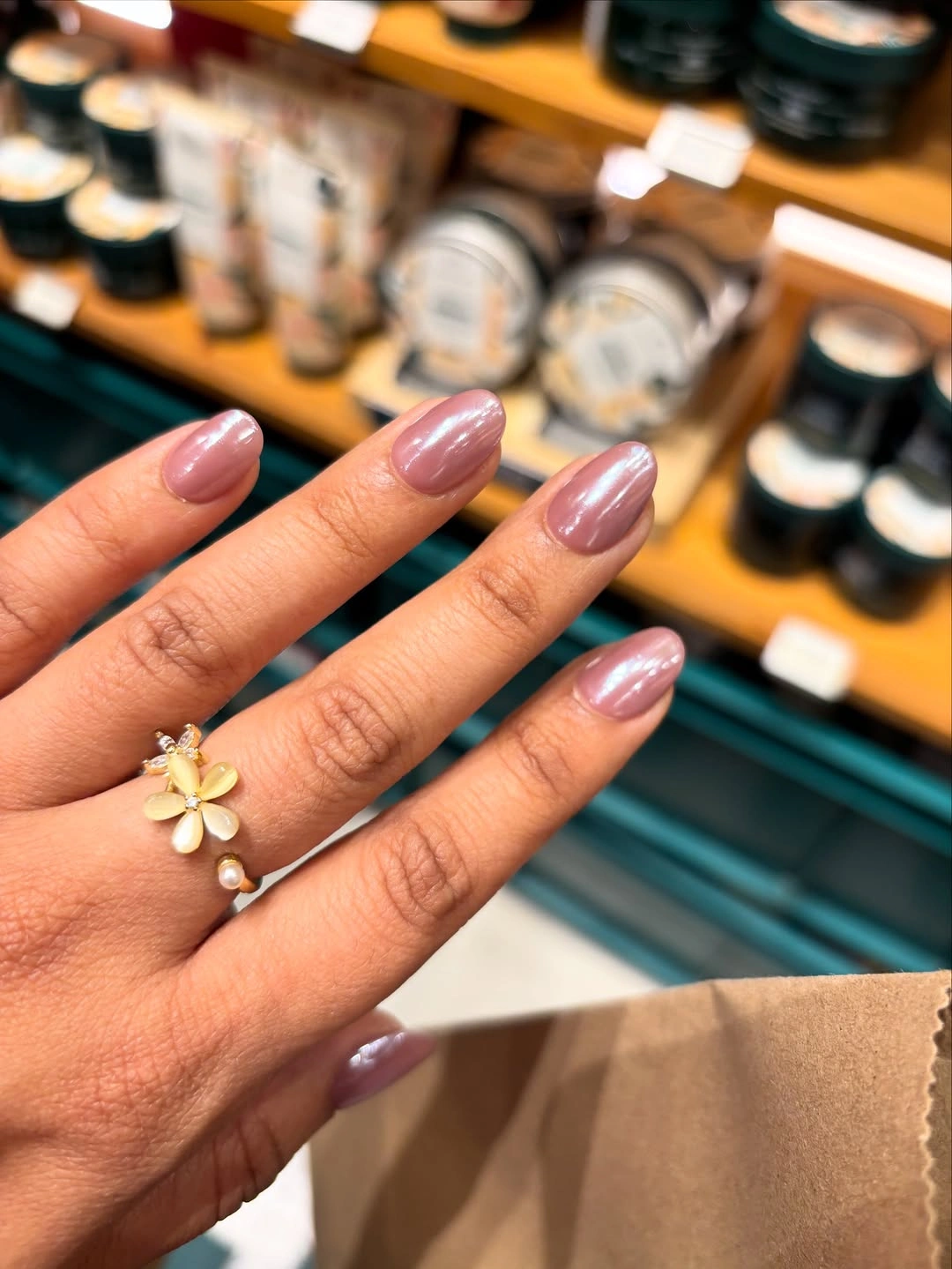
The restraint is useful because a softer color can still look deliberate on brown skin when the shape is even. The mauve has enough depth to stay visible, yet it does not compete with jewelry or clothing. If the full set feels too understated, one nail could carry a fine brown line or a slightly deeper berry tone while the rest keep the same quiet base.
A shorter almond would make this a practical everyday option, especially for someone who likes a refined outline without much detail. The glossy surface rewards a smooth contour and will reveal dents more readily than a textured finish, but that is also what gives the color its calm polish. Letting the form stay visible is the whole point, so extra decoration would be unnecessary here.
Smoky two-tone panels on long square nails
Long square nails give a pale pink center a graphic frame through smoky bands that shift between brown and blue-gray near the tips. Small silver studs appear on selected nails, but they are secondary to the broad two-tone panels. The repeated block placement makes the set feel coordinated even though the dark tips are not a single flat color.
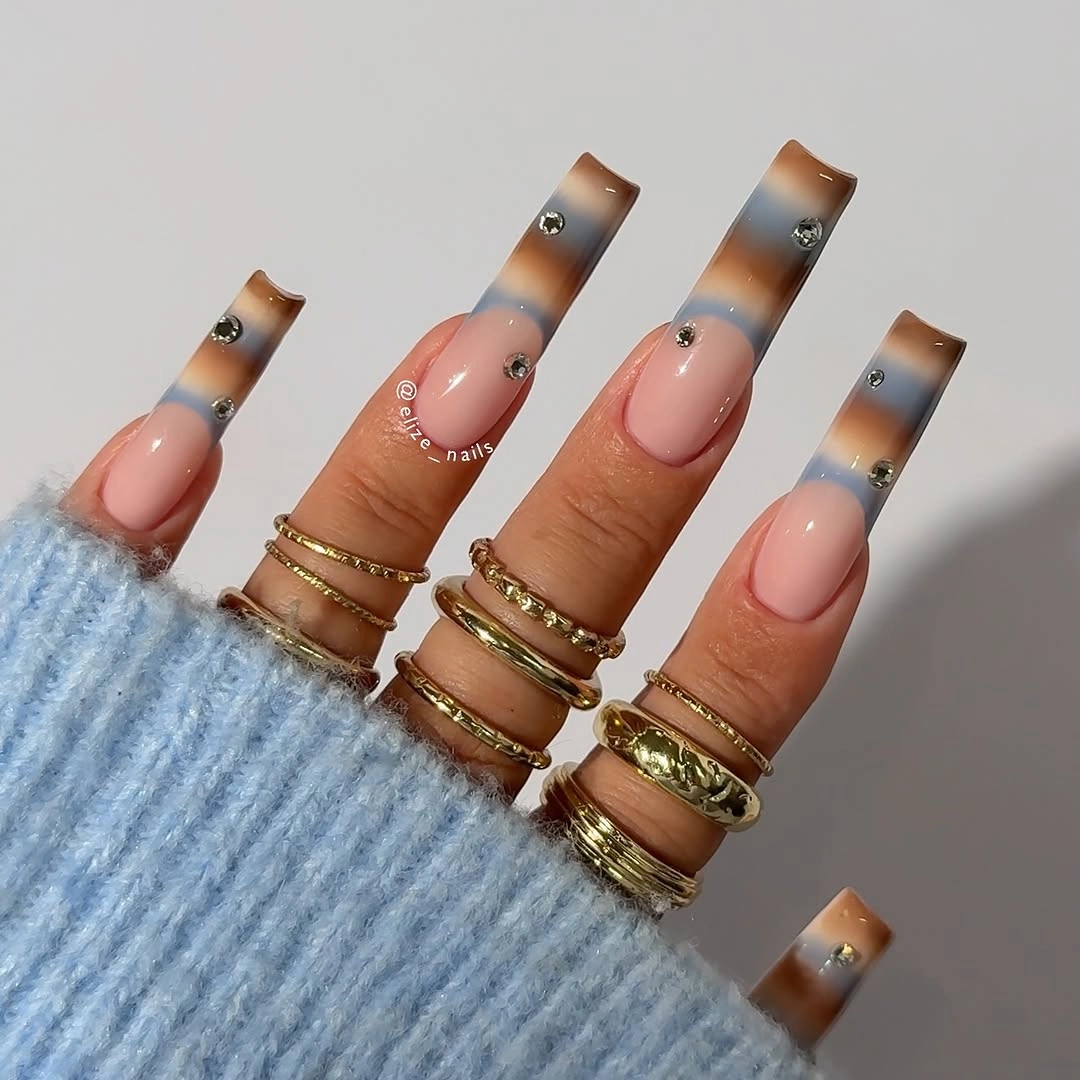
The pale center keeps the dark bands from becoming visually heavy, while the squared edge gives each panel a firm boundary. This is a useful route for fall nails for brown skin tone when you want more structure than a thin French line but less coverage than a full dark coat. A shorter square can preserve the two-tone relationship, although the band may need to be narrower to leave enough room for the base.
The small studs add a bright point, yet they also introduce the main upkeep issue along with the long corners. If daily tasks make that combination inconvenient, remove the studs and keep the smoky band on two accent nails. The color can also move warmer or cooler without changing the logic: the important choice is the separation between a light center and a shadowed edge.
Tortoiseshell-style accents warm a nude almond
A glossy pink-nude almond base becomes more expressive when a few nails switch to amber-brown marbling, dark curves, white sections, and tiny gold star-like details. The accents are concentrated rather than repeated across every nail, which leaves the pale base doing most of the visual work. Long almond length gives the mixed details room to remain distinct.
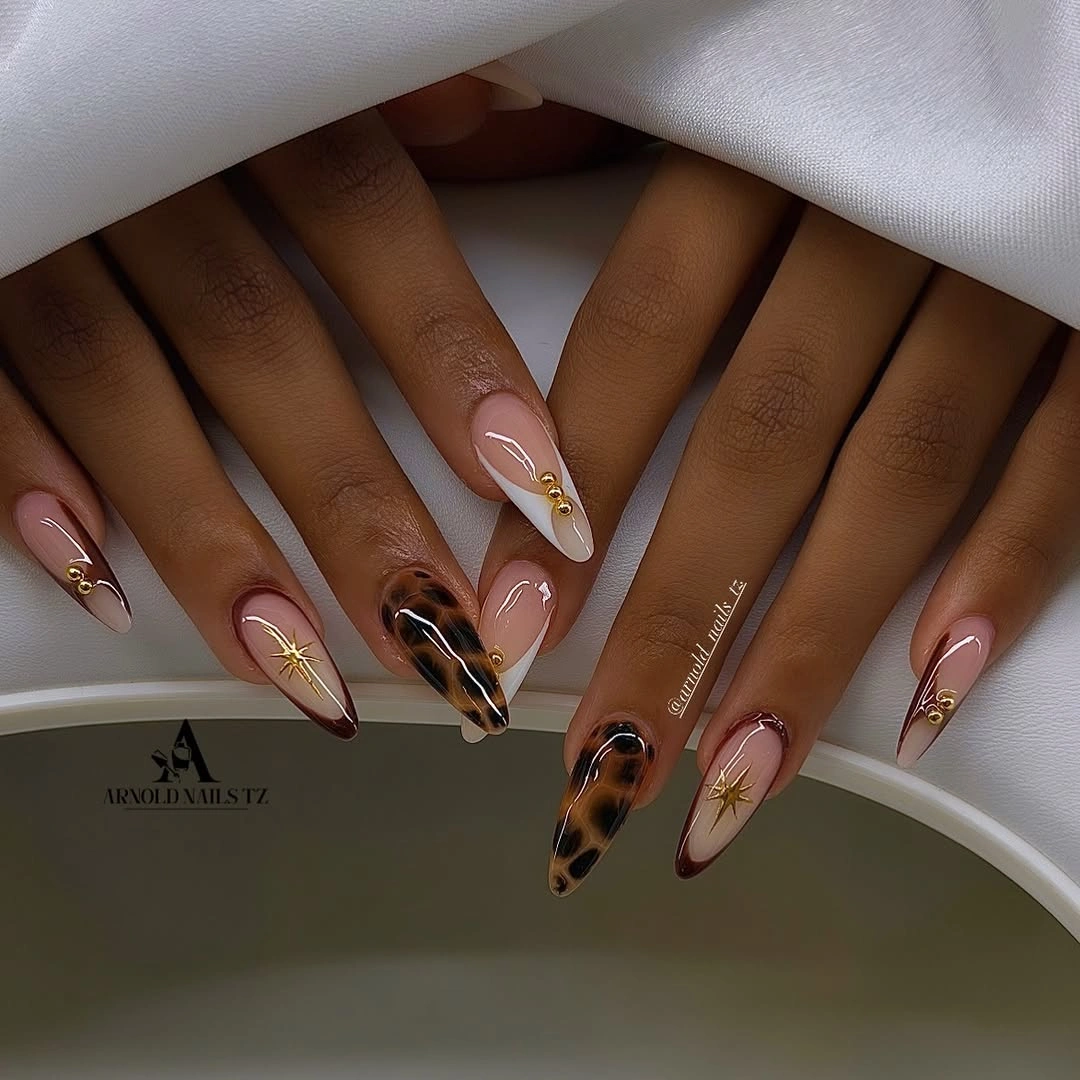
The contrast works because the warmer brown accents echo the skin tone without blending into it, and the gold points add a small flash rather than a second dominant motif. This is more controlled than a full patterned set, so one marbled nail and one gold mark could be enough for a shorter version. Keeping the neutral nails plain also prevents the different accent shapes from competing for the same focal spot.
The longer taper is part of the elegant rhythm, but it carries a practical cost when the design includes several small details. If you prefer a lower-maintenance interpretation, keep the amber-brown accent and replace the gold marks with a simple curved line. The palette remains fall-ready through warmth and contrast, not through the number of decorations added to each nail.
One gold-framed accent creates a small focal window
Most of this medium almond manicure stays glossy and pale pink, while one nail receives a small gold frame around a light textured-looking center. That single border changes the scale of the set: the base remains quiet, but the eye gets one compact place to pause. The accent is visible because the surrounding nails do not ask for equal attention.
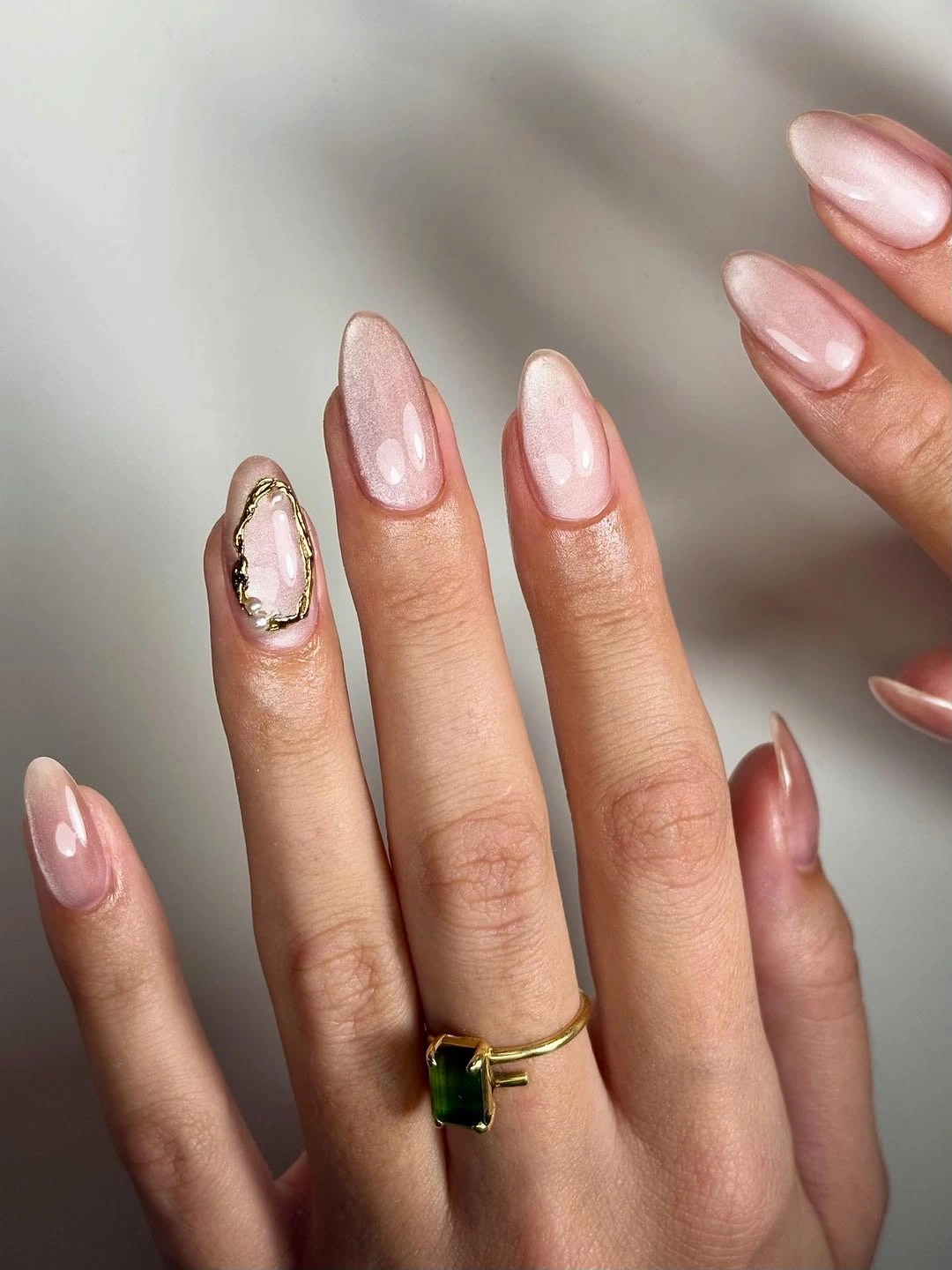
The design is a useful example of how fall nails on brown skin tone can use a tiny warm detail instead of a full seasonal pattern. A shorter oval would still support the framed accent, and the border could be simplified to a thin gold curve if the center feels too busy. The important relationship is the small focal window against several uninterrupted nails.
There is also an upkeep advantage to keeping the detail isolated: a single accent is easier to refresh than a repeated frame across both hands. The gold border needs precision, though, and any growth around the edges will change its spacing. If you prefer a more restrained finish, use one gold dot in the center and leave the pale base completely open around it.
Pastel tips keep the pink base in motion
Medium almond nails carry a glossy pink base with a different pastel tip on each finger, including soft yellow, blue, green, and orange. The French placement repeats, but the edge color changes, so the set feels lively without turning into full nail art. The rounded taper gives the mismatched palette a gentle outline.
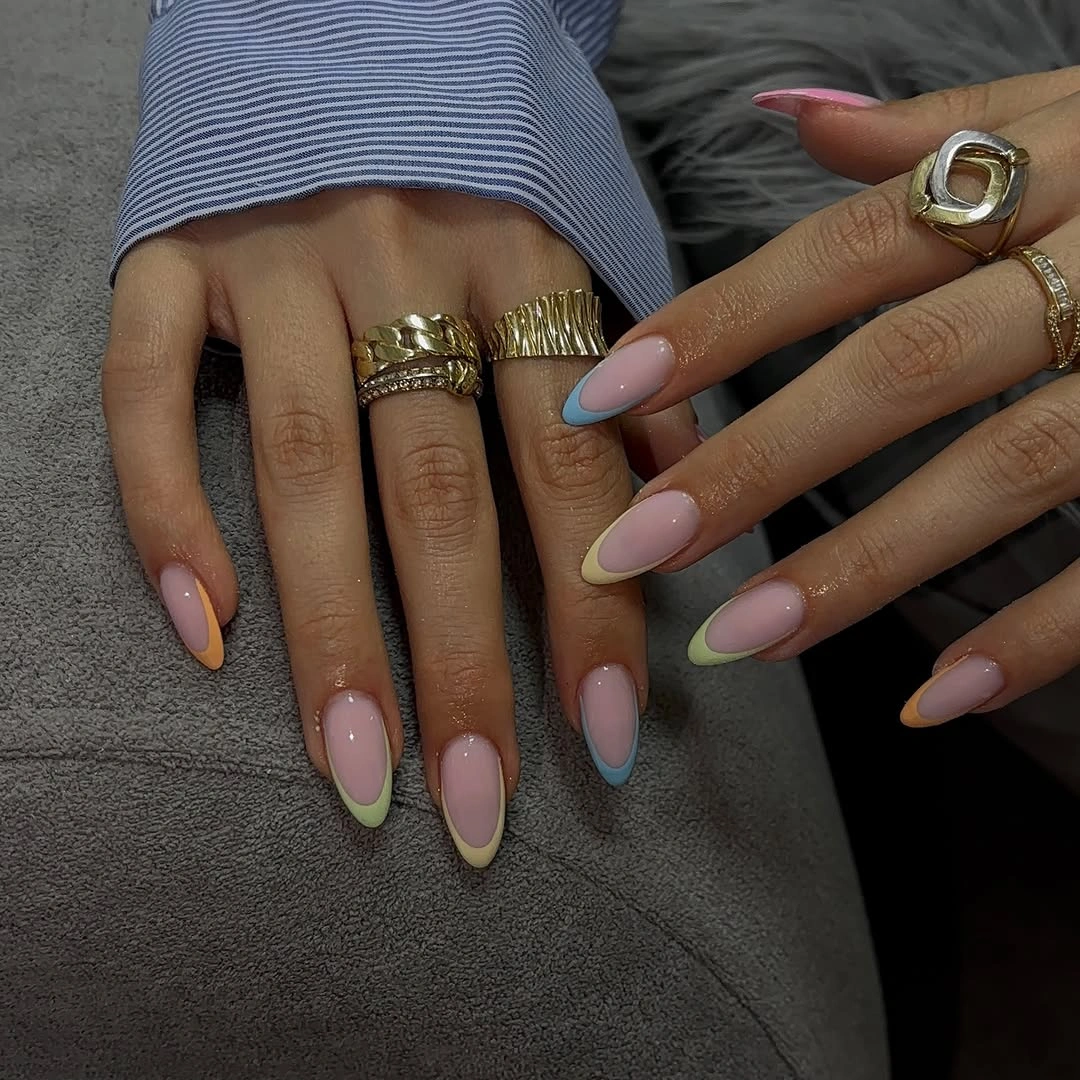
The open base matters here because it keeps four colors from becoming too dense. The shades are bright enough to show against brown skin, yet their pastel value makes the transition softer than a neon block. If you want a more autumnal direction, keep the same structure and replace one pastel with muted rust or olive, using the color change as the accent rather than adding a new motif.
A short oval can carry this idea especially well because the color stays near the edge and does not depend on extreme length. The narrow tips will reveal uneven curves, so consistent placement is more important than exact color matching. Keeping two or three shades instead of four would make the manicure easier to coordinate while preserving the repeated color rhythm.
Yellow edges meet berry pattern details
Long almond nails use a translucent pink center, bright yellow tips, and burgundy rounded dots or checker-like marks on selected free edges. Tiny gold points appear near some accents, adding a warm flash without changing the main palette. The yellow lifts the base, while the berry details pull the look back toward deeper fall color.
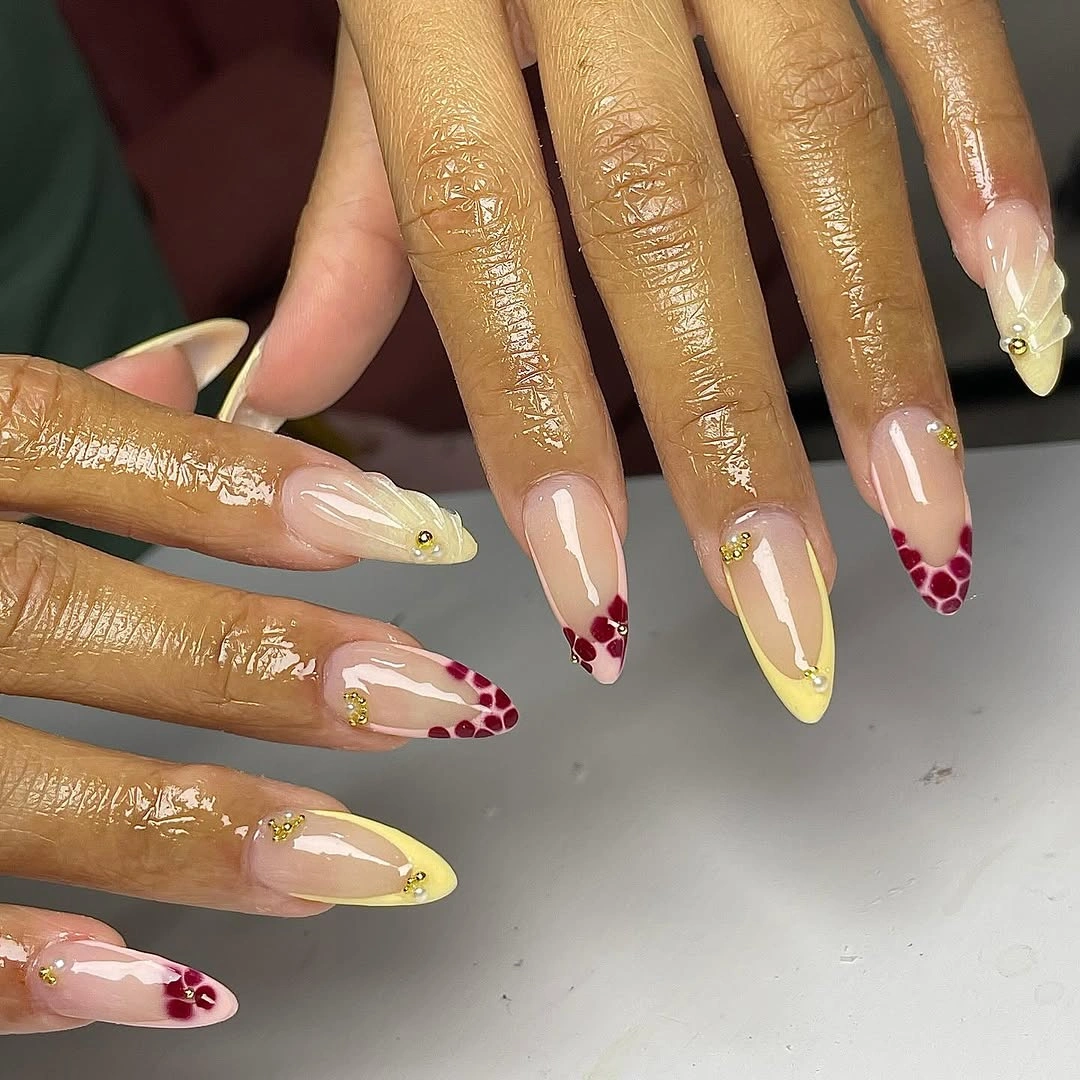
This arrangement works because the patterned nails are allowed to be the focal points and the plain yellow tips act as relief. The dark red-brown marks have more weight than the yellow, so they anchor the set against brown skin instead of making it feel purely playful. A shorter almond could keep one patterned tip and use a simple yellow edge on the rest.
The design has more upkeep than a plain French manicure because both the pointed length and the small pattern need to stay crisp. If that feels like too much, reduce the burgundy marks to a few dots and let the yellow carry the color story. The most coherent version keeps the warm tones related and avoids adding a third unrelated accent shade.
Fine gold lines sharpen a nude square
Medium-long square nails remain pink-nude through the center and finish with very thin gold lines at the tips. The metallic edge is delicate and continuous, so it gives the shape a warm outline without introducing a solid second color. The dark skin underneath makes the narrow line readable even though the manicure stays understated.
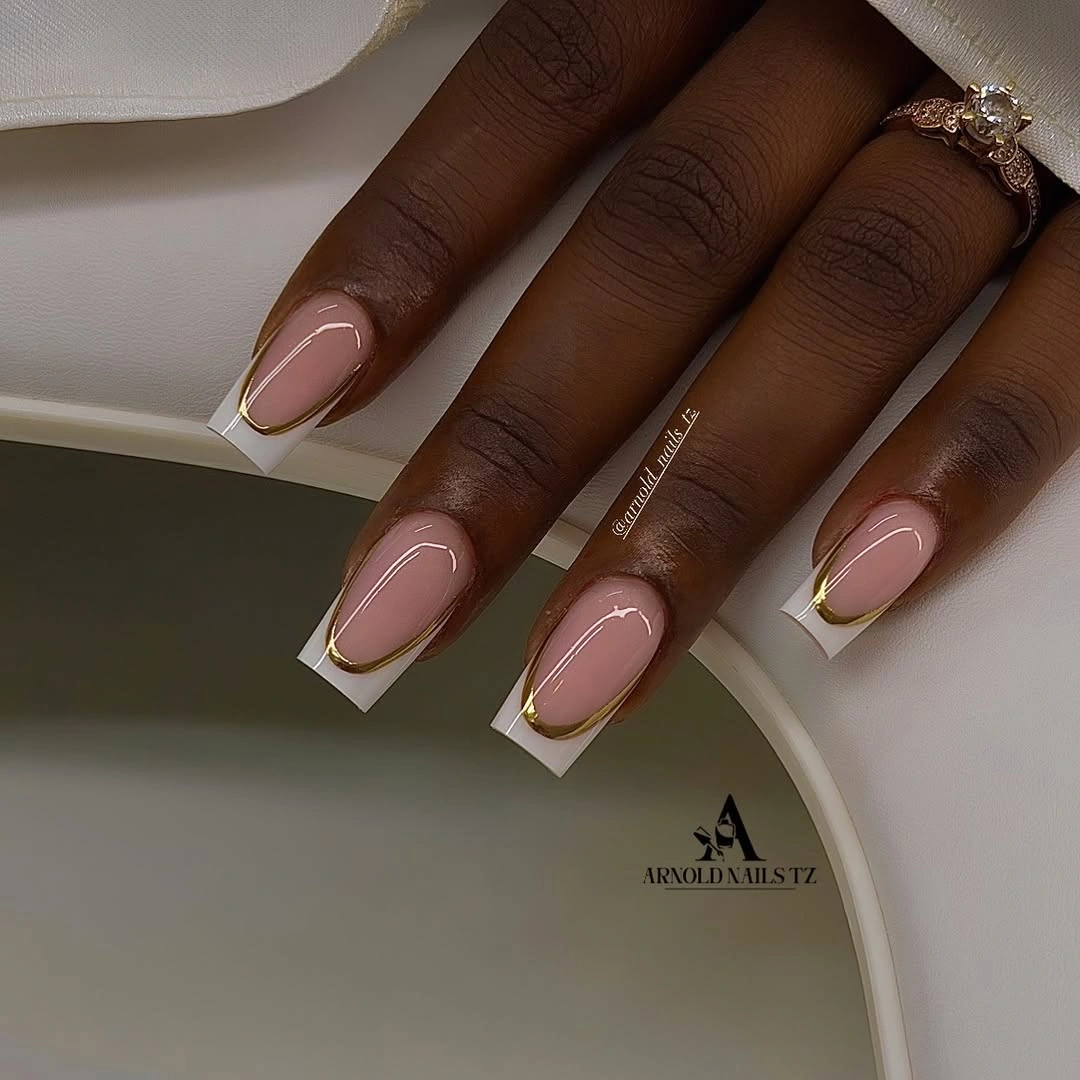
The appeal is in the spacing: the gold does not crowd the cuticle or cover the full tip, leaving the nude base open. This makes a polished alternative to the more decorated fall burgundy nails with design, especially if you prefer a warm accent that remains neutral. A shorter squoval can keep the same edge, provided the line follows the curve evenly.
Fine metallic borders are precise by nature, so a broken or uneven line will show more than a textured accent would. A useful simplification is to keep the gold on two nails and leave the others entirely nude-pink. That change lowers maintenance while preserving the original decision: let one thin edge, not a pile of decoration, define the manicure.
Soft white curves and tiny gold points
Medium almond nails combine a pale pink center with rounded white sections near the tips and small gold bead-like points on selected nails. The white details are curved rather than sharply geometric, and subtle raised-looking marks add a little dimension. The overall palette stays light, but the gold keeps it from becoming visually plain.
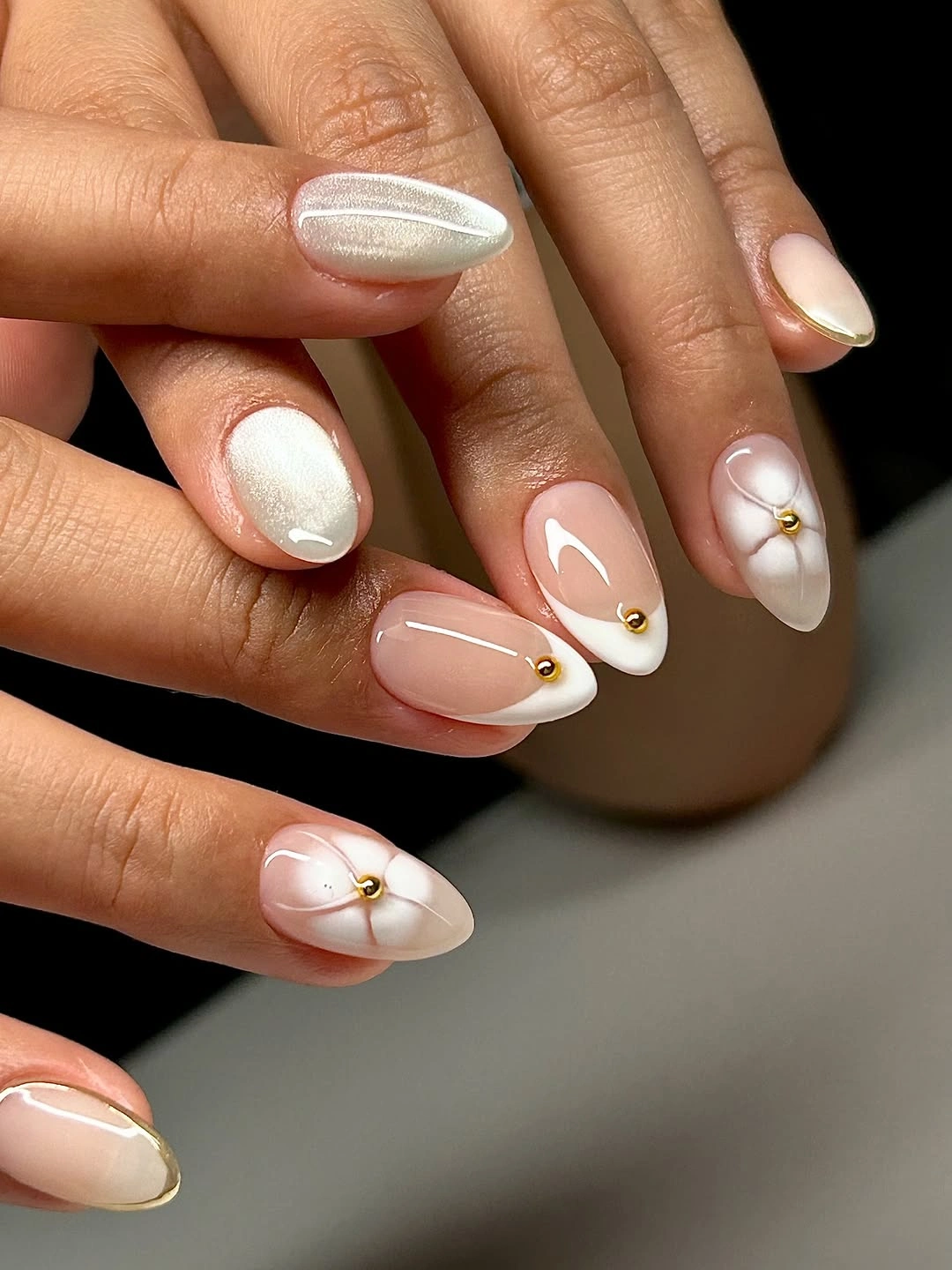
The rounded placement echoes the almond shape, which is why the decoration feels integrated instead of pasted on. On brown skin, the light white sections have a clear edge while the pink base keeps the contrast gentle. A shorter oval can support the same idea if the white curves are simplified and the gold points are limited to one accent nail.
Small embellishments bring a realistic maintenance question: they may need more attention than a flat painted line, especially when placed near the tip. If you want the visual effect without the extra detail, use white crescent tips and one gold dot on each hand. That preserves the soft ornament while leaving more open space for the nail shape to read.
Micro silver edges add light to pink almond nails
These medium almond nails use a glossy pink center and narrow silver-white edges that catch light only along the free tips. The reflective strip is fine enough to feel like a glint rather than a full metallic manicure. Because the base remains close to the natural pink family, the taper and the thin edge carry the whole design.
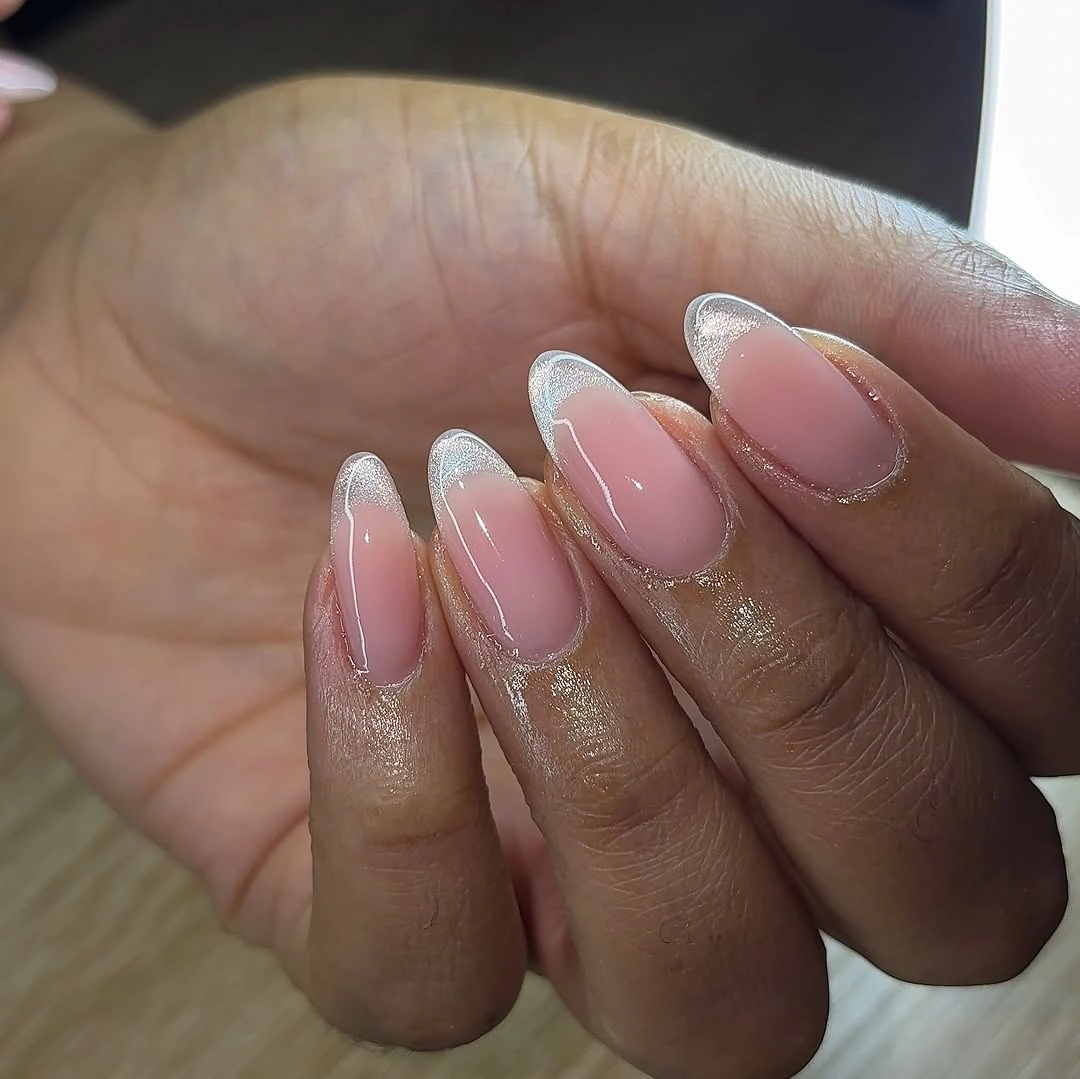
The small edge is a smart choice when you want fall nails for brown skin tone with a little brightness but no dense art. A short oval can keep the idea, though the line may need to be slightly more visible to survive the reduced length. A warmer beige-pink base would soften the contrast, while a deeper mauve would make the same edge more graphic.
Fine tips are not maintenance-free: growth changes the distance between the edge and the cuticle, and any uneven curve becomes visible. Still, the low detail makes repairs simpler than a full pattern. Keep the rest of the hand quiet and the silver-white line remains a small, controlled color moment rather than a competing feature.
Muted taupe-mauve with pinpoint highlights
Short-to-medium rounded nails carry a glossy taupe-mauve shade that sits between soft brown and dusty pink. Tiny pale reflective marks appear near selected nails, interrupting the solid color without becoming a motif. The compact shape and muted base make this one of the quieter choices in the set.
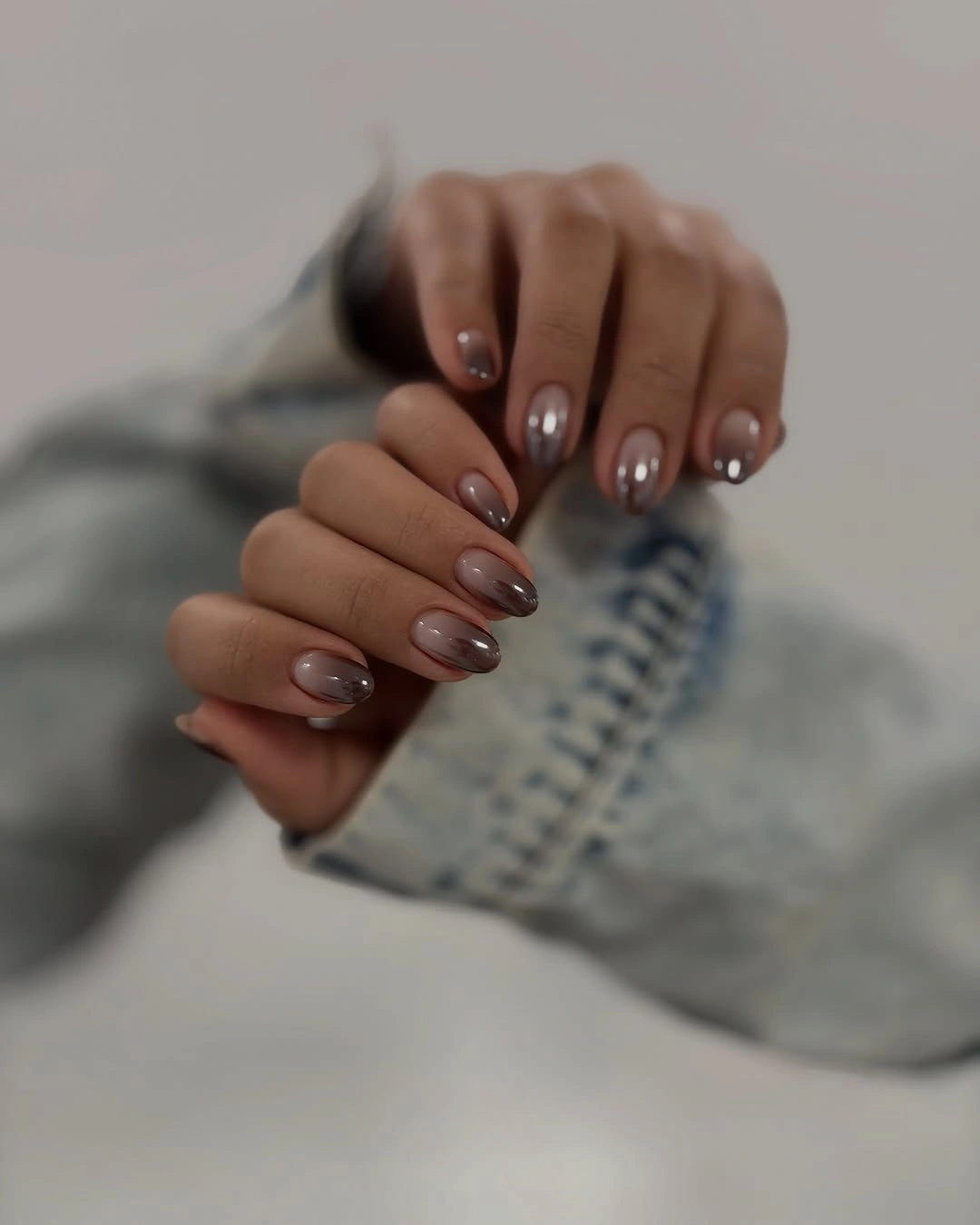
The color has enough warmth to sit comfortably in a fall palette, but it does not rely on darkness to create contrast. That makes it useful when you want a low-detail manicure that still feels considered on brown skin. A short round or squoval would work equally well, and the tiny marks can be kept to one accent nail if you want less visual interruption.
The tradeoff is subtlety: in low light the muted shade may look flatter than the glossy burgundy or navy options, so the contour needs to be clean. Small highlights should support the color rather than compete with it. If you need more depth, shift the base toward chocolate mauve instead of adding more decoration to the surface.
Champagne lines emphasize a long stiletto
Very long stiletto nails use a nude beige-pink base with fine gold or champagne lines that travel along the pointed shape. The design is mostly linear, so the extreme taper becomes the central feature rather than a canvas for large motifs. Pearl jewelry and dark fabric intensify the warm contrast, but the manicure itself remains focused.
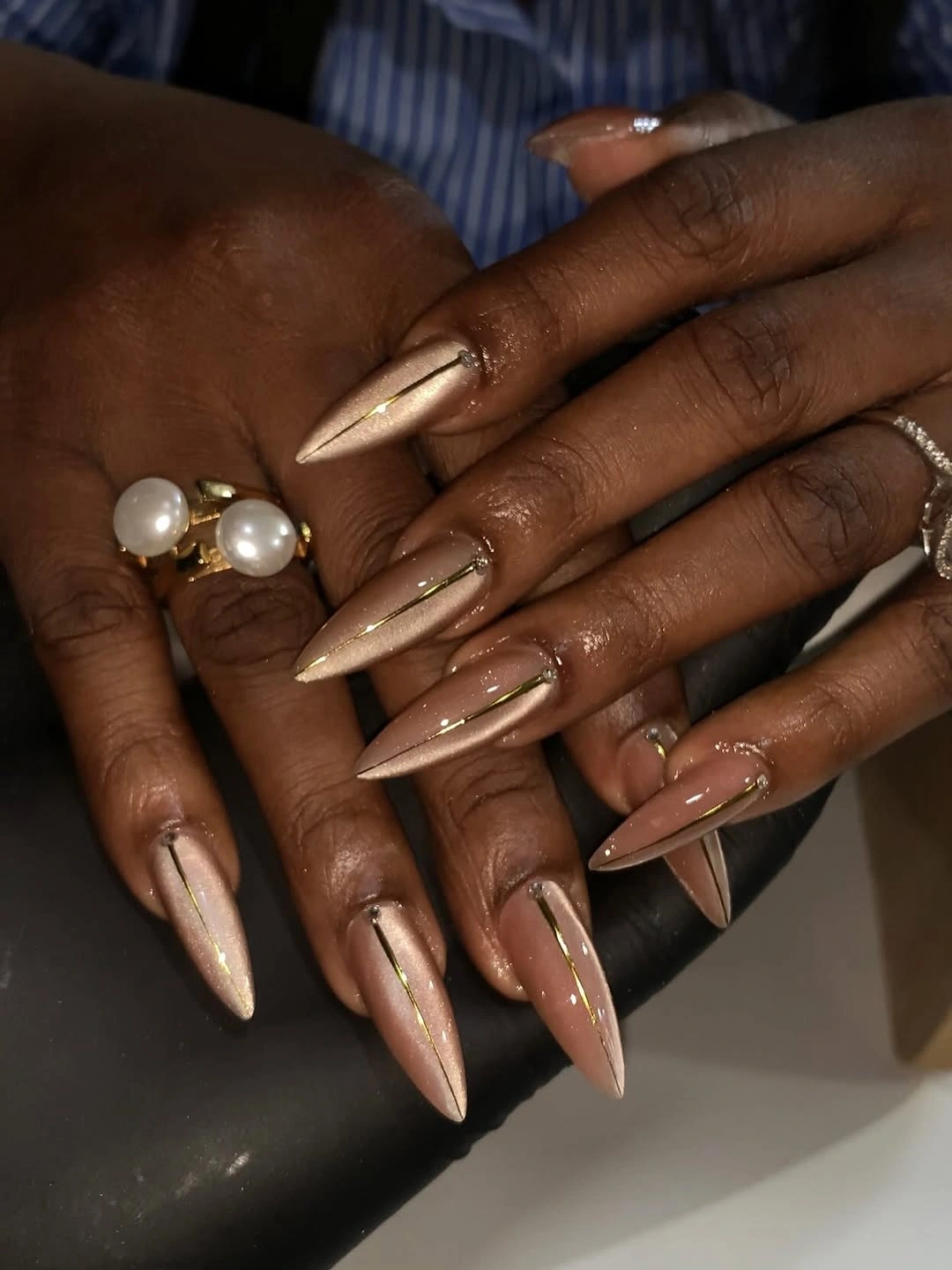
The metallic lines make the points look even longer, which is why the nude base is useful: it gives the eye a clean path from the hand to the tip. For a more practical interpretation, move the same palette to a medium almond and keep one line near the edge. That keeps the elongating idea while reducing the daily demands associated with very sharp length.
This is a statement silhouette, and pretending otherwise would miss its main tradeoff. Stiletto tips are less convenient for some routines, and a small break in a long line can be obvious. If you love the color relationship but need comfort, use champagne on two accent nails and keep the rest softly nude, letting the metallic detail stay intentional rather than overwhelming.
Outlined gold almond tips with open space
Long almond nails return to a pink-nude base, but this time a thin gold line traces the outer tip and side curve rather than sitting as one solid band. The contour follows the taper closely, creating a delicate frame around the free edge. Dark skin and white fabric make that warm line easy to distinguish.
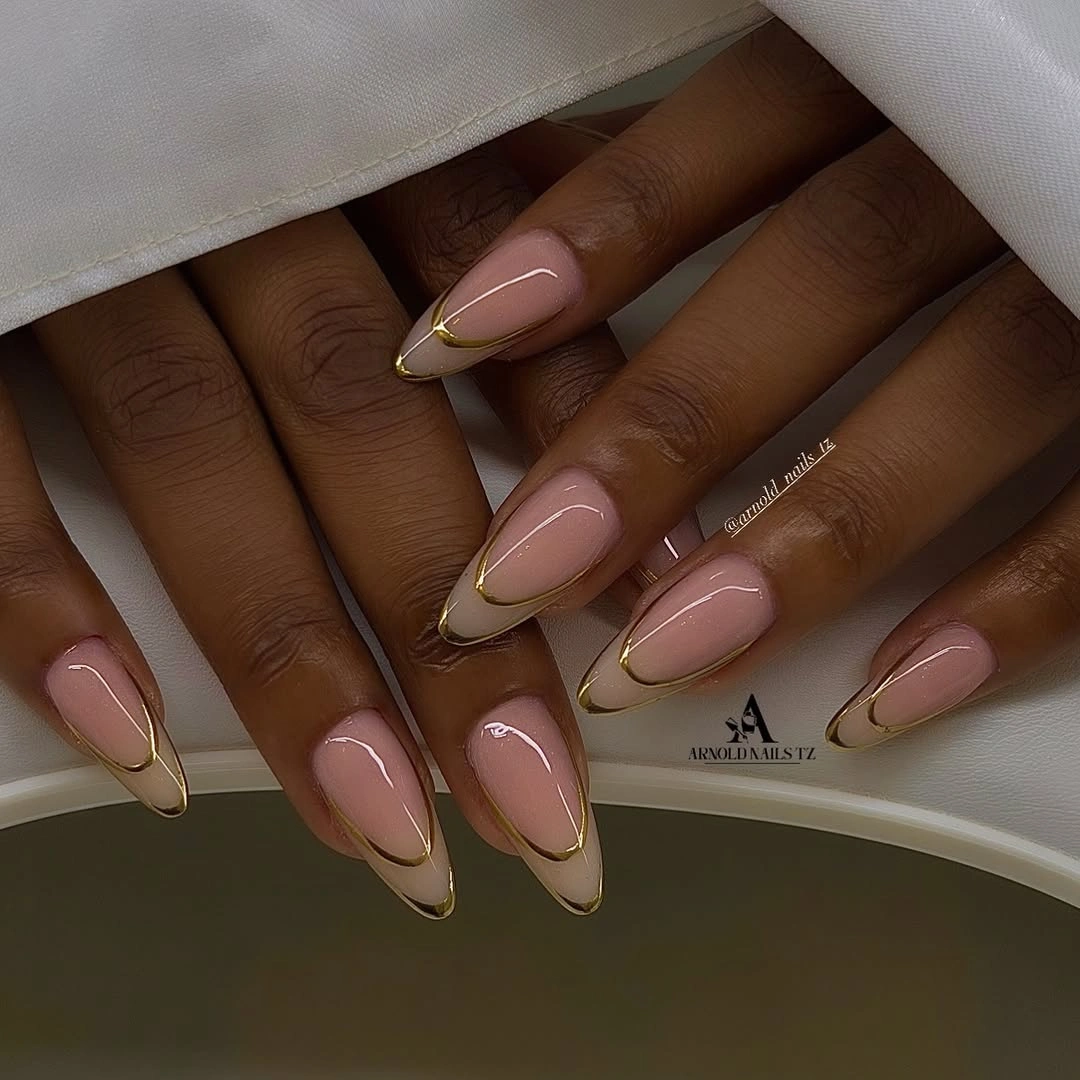
The outlined construction works because it preserves negative space inside the tip, so the nail still looks light even when the length is generous. This is a good shape-led alternative to fall long nails with heavier decoration. A shorter almond can keep a single curved outline, but the spacing should remain even so the contour does not look accidental.
Precision is the honest limitation: a full contour needs steady distance from the edge, and growth will change that relationship. For lower upkeep, use the gold only on two nails or turn it into a simple V-tip. The warm line should frame the nude center, not disappear under extra details that would take away the clean contrast.
Neon graphic panels make every nail a statement
This long mixed set treats each nail as a separate graphic panel: bright pink waves, translucent orange, yellow and blue stripes, and black-and-white curves all appear within one hand. The shapes are long and pointed or tapered, and the high contrast is intentionally irregular. There is no single repeated motif beyond the decision to let color and line movement change from nail to nail.
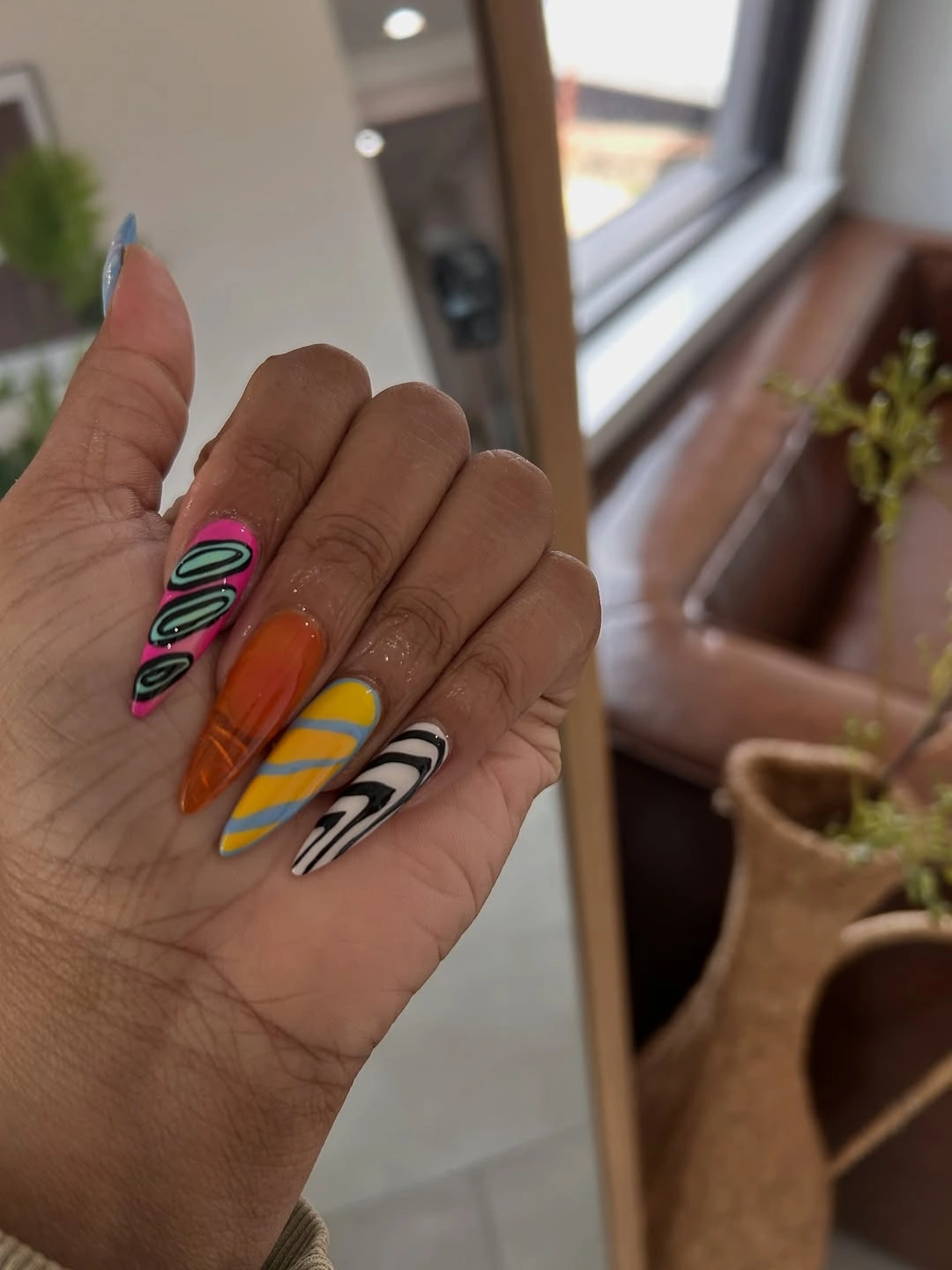
The design succeeds because the neutral skin around the nails and the small areas of open base give the bold colors somewhere to stop. It is an expressive route for fall nails on brown skin tone, but it is not the quiet option. A shorter set can borrow one wavy line, one stripe, and one bright solid, reducing the palette while keeping the lively composition.
Different details will wear at different speeds, and the long tips add their own practical limitation, so this set rewards someone who enjoys regular attention. If you want to make it more seasonal, deepen one orange or pink accent toward rust while leaving the blue and black lines intact. The collection stays coherent when the changes are concentrated rather than added everywhere.
Pink flowers and yellow tips on pointed nails
Very long stiletto nails begin with a pale pink base, then build toward bright yellow tips, raised-looking pink flowers, small stones, and thin line accents. The pointed shape is dramatic before the decoration even begins, and the flowers concentrate attention near the tips. The warm yellow gives the floral work a sharper edge against the skin tone.
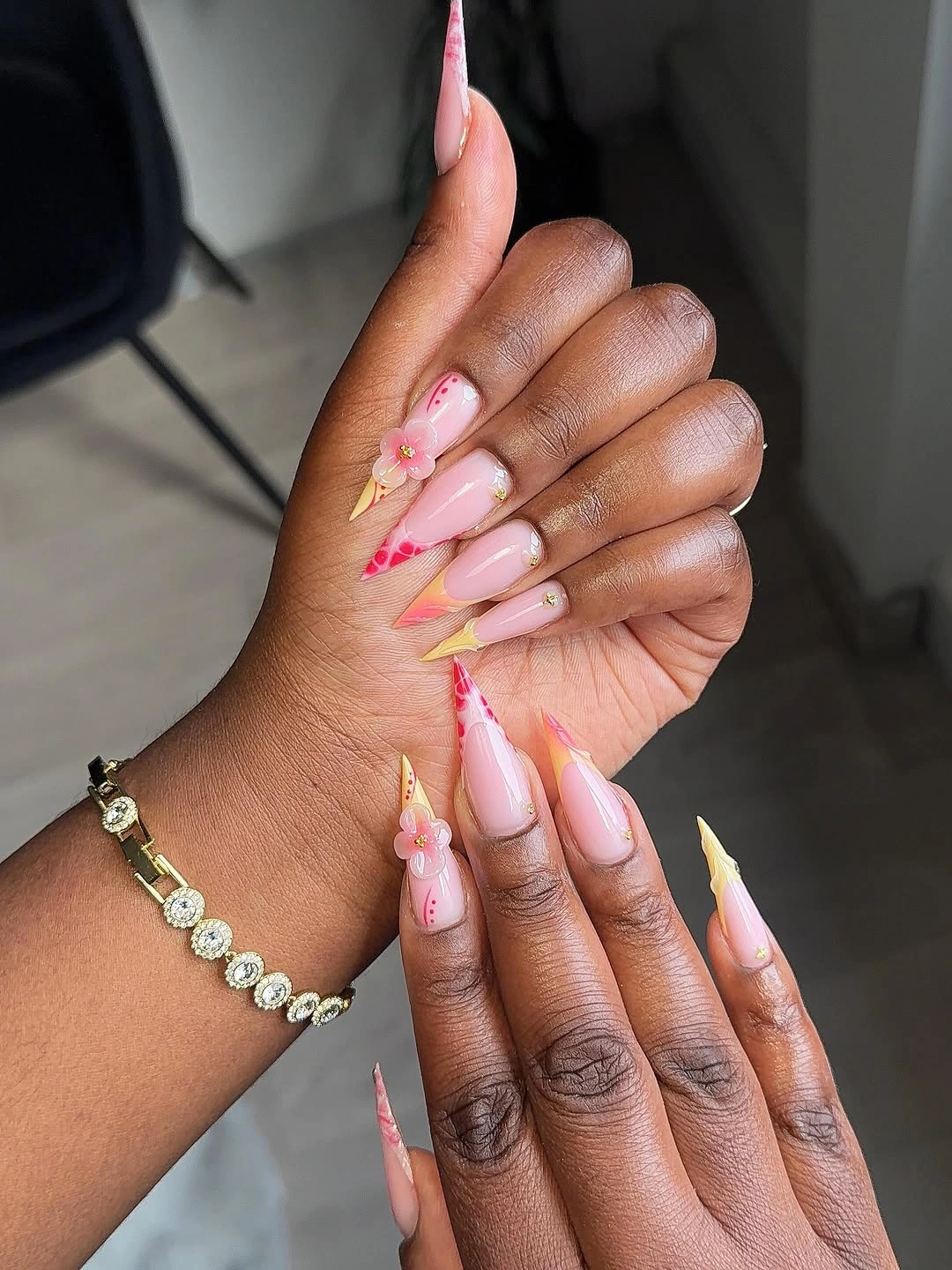
This is maximalist because several choices arrive together: extreme length, contrasting tips, floral volume, and small sparkle. The palette still feels connected because pink and yellow repeat as the strongest colors. For a more wearable edit, keep one flower and one yellow tip on a medium almond, letting the remaining nails return to glossy pink.
That reduction is not a compromise in taste; it changes the maintenance equation. Very long points and raised-looking accents may catch during daily tasks, while a smaller floral focal point keeps the same playful color relationship. If the design stays long, simple edge care and careful placement matter more than adding another charm or shade.
Glossy navy gives a short shape depth
Short-to-medium rounded nails are painted a solid deep navy-blue shade with a glossy reflection and no visible art. The color becomes lighter where the light hits and almost ink-dark at the edges, so the surface has enough variation to stay interesting. The compact silhouette keeps the saturated tone from feeling overextended.
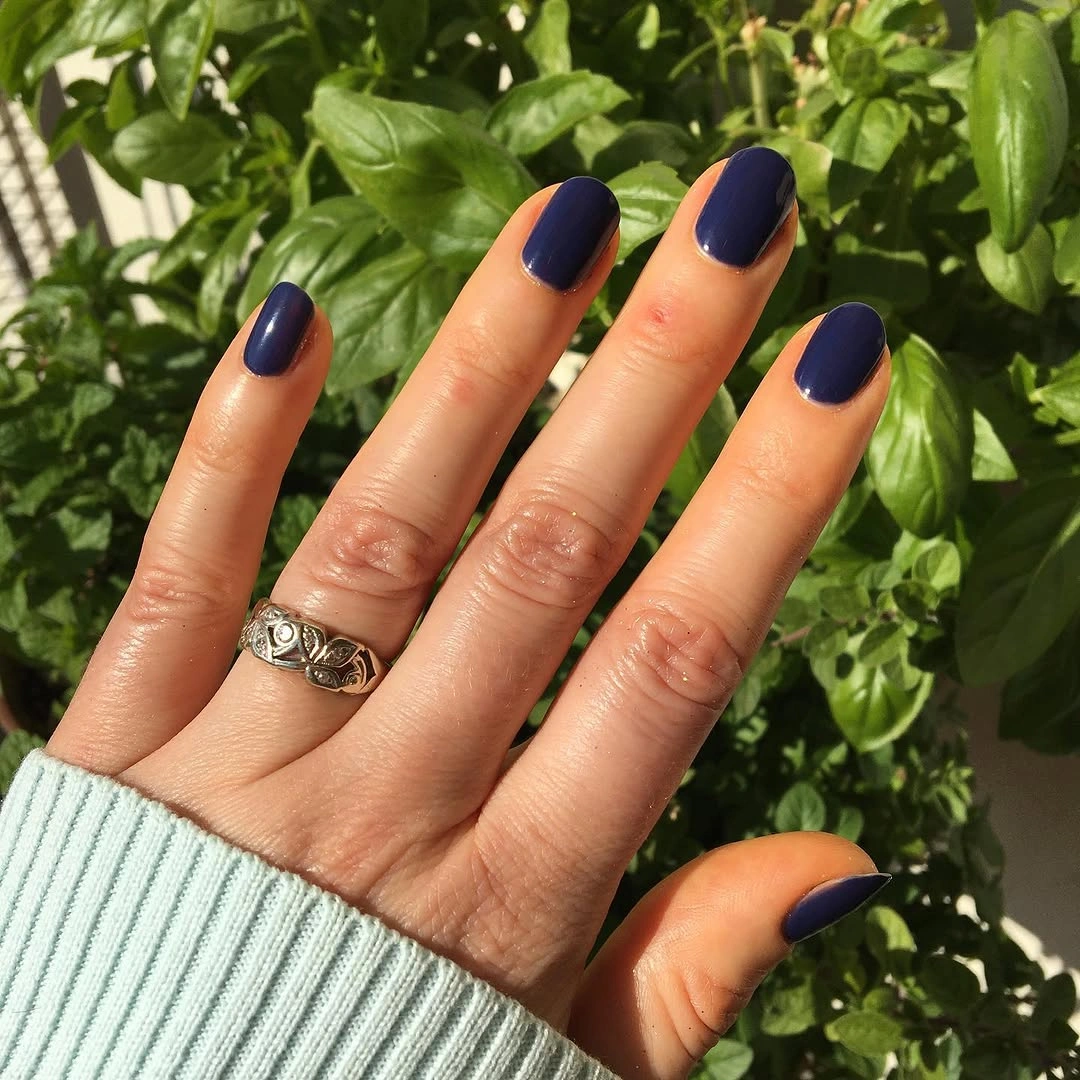
Navy offers a cooler alternative to burgundy and brown while still carrying the depth expected from fall nails for brown skin tone. The clean solid surface also makes the design easy to translate to a short round or squoval. For a broader undertone comparison, see fall nail colors for dark skin. If you want a softer version, choose a blue-black or muted ink tone; the key is keeping the shape neat and the finish even.
A dark glossy coat will reveal chips, especially against a simple background where there is no art to distract from the edge. That is the practical limit, but it is also why this manicure looks strong when maintained. Resist the urge to add multiple accents: the color already provides the contrast, and a single shade is the coherent choice.
Bright flowers and playful tips at maximum length
Very long stiletto nails use a glossy pink base with yellow, orange, and white tips, then add purple flower-like decorations and small colorful charms. The palette is brighter and more varied than the single-flower design, and the pointed length gives each accent room to stand apart. The strongest visual movement comes from the warm tips against the cooler purple details.
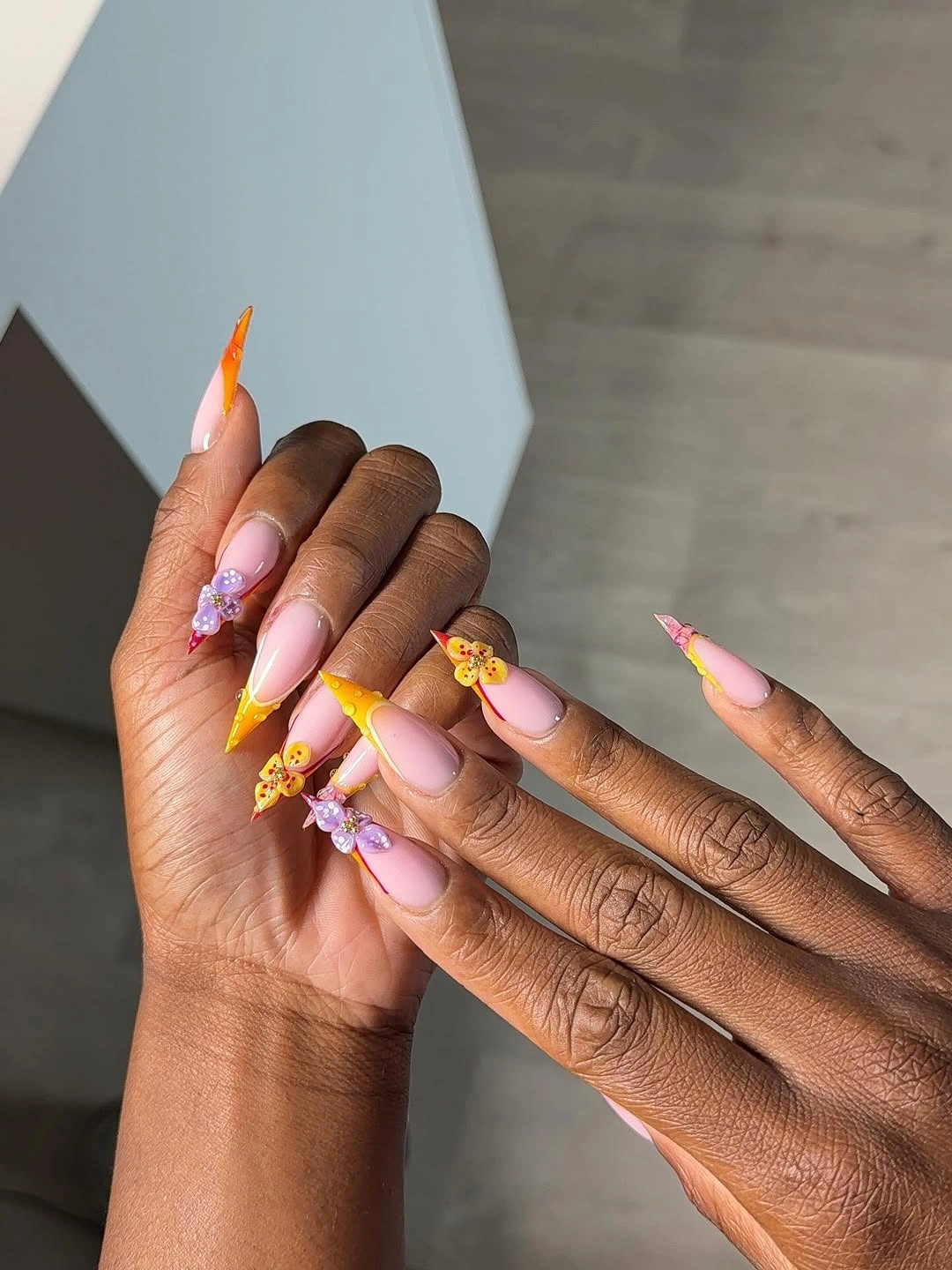
The colors work because the pink base acts as a quiet bridge between warm yellow-orange edges and cool purple embellishments. This is the fun option for someone who wants the manicure to read as an accessory, not a background detail. A medium almond version could keep one purple flower and one bright tip while removing the extra charms.
The design is more maintenance-heavy than its soft base suggests. Long points, several tip colors, and small raised-looking details can all need separate attention, and the pale pink center will show marks. Keeping the brightest colors concentrated at the edge gives the set a clear direction; spreading even more color across the base would reduce that balance.
Metallic color blocks brighten square tips
Medium square nails combine a glossy pink-nude center with reflective color blocks at the tips, including blue, purple, coral, and green, framed by fine gold or dark lines. The geometric panels stop at the free edge, so the base remains open and the square shape stays visible. Each block changes the color story without changing the basic placement.
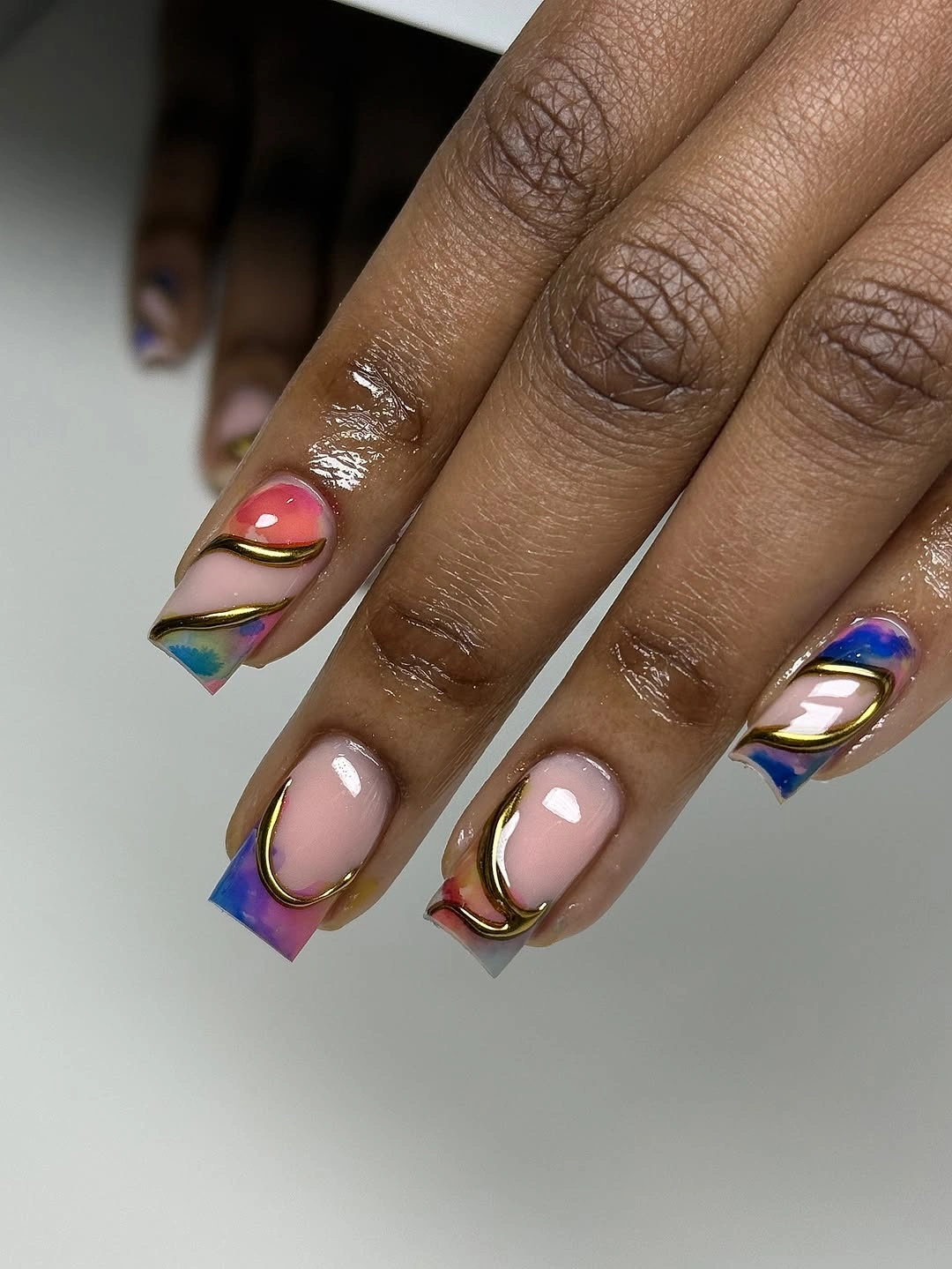
This is a useful middle ground between a solid color and full nail art. The reflective ends create a small burst of contrast against brown skin, while the pink-nude center prevents the colors from feeling too dense. A shorter squoval can keep one or two metallic blocks, and using only complementary shades will make the set easier to coordinate with clothing.
The main limitation is alignment: hard-edged panels need clean borders, and growth changes the distance between the block and the cuticle. If you prefer a softer effect, replace the gold frame with a curved color edge or move the blocks to two accent nails. The design stays convincing when the center remains calm and the color stays concentrated at the tips.
Black and white patterning frames a nude almond
Long almond nails finish a glossy nude-pink center with black-and-white geometric sections at the tips. Some edges look triangular or lattice-like, while the rest of the nail remains open and pale. The sharp taper gives the pattern enough room to read as a deliberate border rather than a small isolated mark.
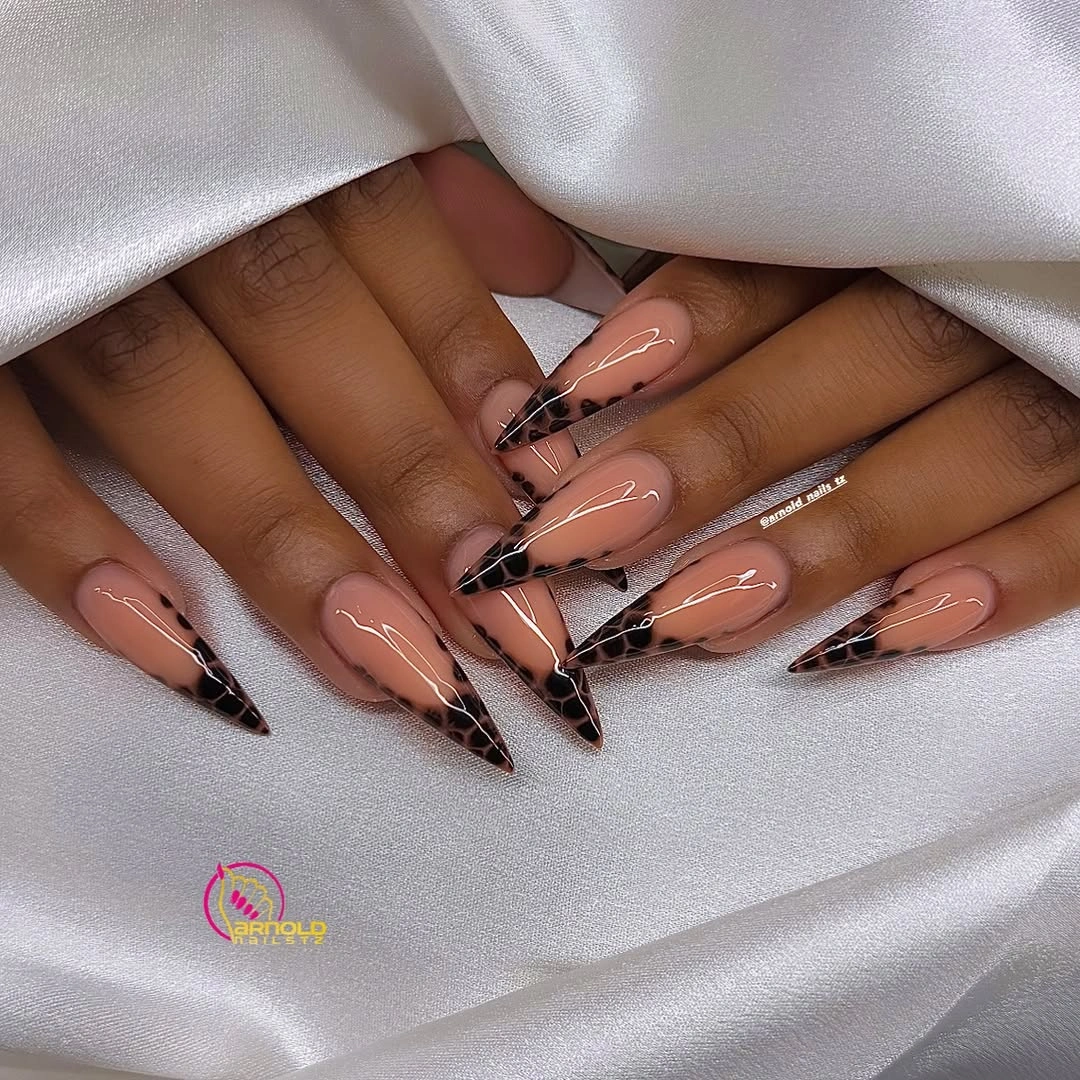
The high-contrast edge is especially clear against brown skin, but the nude center keeps the overall hand from becoming visually solid. This is a strong closing idea for fall nails for brown skin tone when you want graphic impact without covering every nail in black. A shorter almond could use a single black curve or a simpler two-tone tip.
Patterned edges need more precision than a plain nude coat, and the long points add a separate wearability question. Reduce the number of lines before reducing the contrast: a clean black-and-white border will remain readable even when simplified. The coherent choice is the boundary between open nude space and a dark patterned tip, not extra decoration inside the center.